

Foreword
Volunteer-run charities are the quiet achievers of Australia’s charity sector.

They are deeply embedded in our communities, often operating behind the scenes to meet local needs, strengthen social bonds, and provide services that neither government nor business can easily deliver.
As someone who began their journey in the not‑for‑profit sector as a volunteer, I understand the value of giving time and energy to a cause.
Volunteering has enriched my life and shaped my career. It is a privilege to now lead the ACNC in presenting this report, Charity by numbers: The volunteer effect.
This companion to the Australian Charities Report 11th Edition shines a spotlight on the 22,000 charities across Australia that are entirely volunteer‑run. These organisations – from school-based parent groups and surf lifesaving clubs to environmental collectives and faith‑based communities – are powered solely by the generosity and commitment of volunteers.
This focus on volunteer-run charities is timely given the 11th edition of the Charities Report, published in June 2025, showed a substantial rise in volunteer numbers. After a decline over several years, volunteer numbers returned to a figure close to an all‑time high – 3.77 million volunteers, up almost 270,000 from the previous report.
In this report we have focused on those charities that are operated solely by volunteers, what we call ‘volunteer-run charities’.
The data tells a compelling story.
Volunteer-run charities are a substantial segment of the overall Australian charity sector – 43% are solely volunteer-run. An additional 9% operate without employees or volunteers (for example, charitable trusts and giving funds that use contractors such as company trustees).
The majority of volunteer-run charities are small or extra small. Despite their modest size, they generated $4.3 billion in revenue and deliver vital services across every corner of the country. Their impact is significant – economically, socially, and culturally.
This report also highlights some of the challenges these charities face, including less access to government funding than larger charities. Because of their size and volunteer nature, they more keenly feel the cumulative load of regulatory compliance, reinforcing the importance of our focus on streamlining reporting across government agencies.
I encourage you to explore this report and reflect on the extraordinary contribution of volunteer‑run charities. Their work is a testament to the power of people coming together to make a difference.
Sue Woodward AM
Commissioner
Australian Charities and Not-for-profits Commission
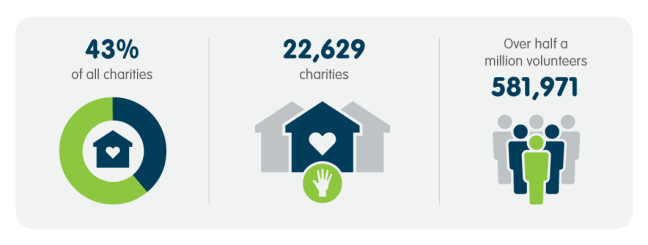
Snapshot of volunteer-run charities
- 43% of all charities
- 22,629 charities
- Over half a million volunteers: 581,971
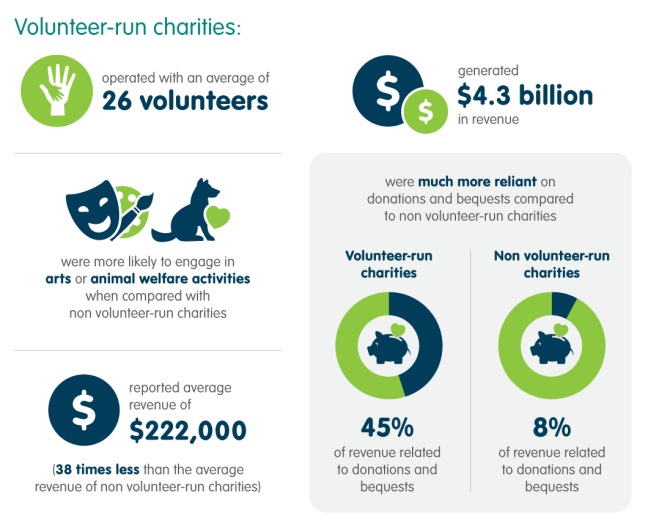
Volunteer-run charities:
- Operated with an average of 26 volunteers
- Were more likely to engage in arts or animal welfare activities when compared with non volunteer-run charities
- Reported average revenue of $222,000 (38 times less than the average revenue of non volunteer-run charities)
- Generated $4.3 billion in revenue
- Were much more reliant on donations and bequests compared to non volunteer-run charities
- Volunteer-run charities: 45% of revenue related to donations and bequests
- Non volunteer-run charities: 8% of revenue related to donations and bequests
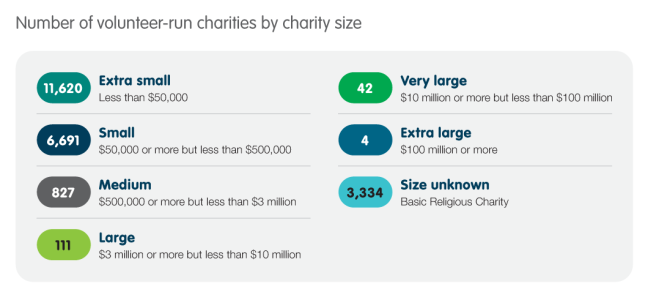
Number of volunteer-run charities by charity size
- Extra small (less than $50,000): 11,620
- Small ($50,000 or more but less than $500,000): 6,691
- Medium ($500,000 or more but less than $3 million): 827
- Large ($3 million or more but less than $10 million): 111
- Very large ($10 million or more but less than $100 million): 42
- Extra large ($100 million or more): 4
- Size unknown (Basic Religious Charity): 3,334
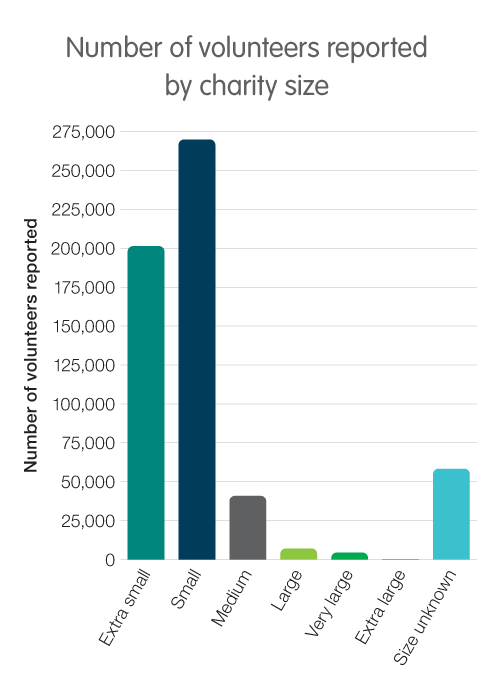
Number of volunteers reported by charity size
- Extra small: 201,297
- Small: 269,761
- Medium: 40,881
- Large: 7,134
- Very large: 4,461
- Extra large: 111
- Size unknown (Basic Religious Charity): 58,326
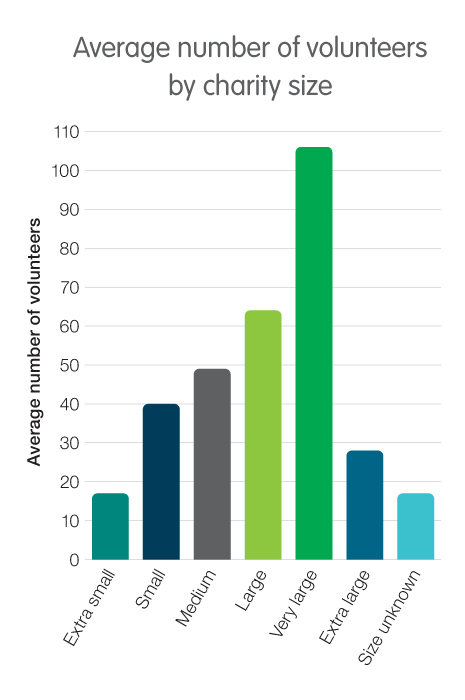
Average number of volunteers by charity size
- Extra small: 17
- Small: 40
- Medium: 49
- Large: 64
- Very large: 106
- Extra large: 28
- Size unknown (Basic Religious Charity): 17
In the Annual Information Statement, charities are asked to report on:
- the number of full-time, part-time or casual staff for the final pay period of the charity’s reporting period
- the number of volunteers the charity had across the entire reporting period, no matter how many hours of voluntary work these people contributed.
For the purposes of this report, a charity is designated as ‘volunteer‑run’ if it reported the following in its Annual Information Statement:
- zero employees in the last pay period
- one or more volunteers during the year.
Our guidance notes that:
- contractors are not considered to be employees
- volunteers can include unpaid board or committee members as well as corporate volunteers (volunteers from a business or commercial organisation).
Our analysis showed that 43% of charities are volunteer-run, with an average of 26 volunteers per charity.
Common examples of volunteer-run charities include Parents and Citizens associations, Returned and Services Leagues (RSLs), landcare groups, surf lifesaving organisations and small local churches.
We know that many charities are initially established as volunteer-run charities by people who feel passionate about a cause. As they grow, they may need to employ staff to deliver services or benefits to the community or simply to manage their volunteer workforce.
The number of volunteer-run charities decreased as charity size (based on revenue) increased – nearly 73% of extra small charities were volunteer‑run, compared to only 10.8% of medium charities, 3.9% of large charities and 1.5% of extra large charities.
Extra small charities operated with an average of 17 volunteers per charity, while very large charities reported the highest average number of volunteers per charity (106).
However, only a small number of those very large charities reported high volunteer numbers, skewing the average. It is common for larger volunteer-run charities to have volunteer board members, and to use contractors or staff paid for by a related organisation or separate management entities.
Table 1: Volunteer-run charities by size
| Charity size | Definition - total revenue | Number of volunteer-run charities | % Volunteer-run charities |
|---|---|---|---|
| Extra small | Less than $50,000 | 11,620 | 72.8 |
| Small | $50,000 or more but less than $500,000 | 6,691 | 42.6 |
| Medium | $500,000 or more but less than $3 million | 827 | 10.8 |
| Large | $3 million or more but less than $10 million | 111 | 3.9 |
| Very large | $10 million or more but less than $100 million | 42 | 1.7 |
| Extra large | $100 million or more | 4 | 1.5 |
| Size unknown - Basic Religious Charity | - | 3,334 | 43.1 |
| Total | 22,629 |
Table 2: Total and average number of volunteers for volunteer-run charities by charity size
| Charity size | Number of volunteers reported | Average number of volunteers |
|---|---|---|
| Extra small | 201,297 | 17 |
| Small | 269,761 | 40 |
| Medium | 40,881 | 49 |
| Large | 7,134 | 64 |
| Very large | 4,461 | 106 |
| Extra large | 111 | 28 |
| Size unknown - Basic Religious Charity | 58,326 | 17 |
| Total | 581,971 | 26 |
Now entering its fourth decade, Southern Women’s Action Network (SWAN) is one of the longest running volunteer-based, women-led, community organisations in Australia.
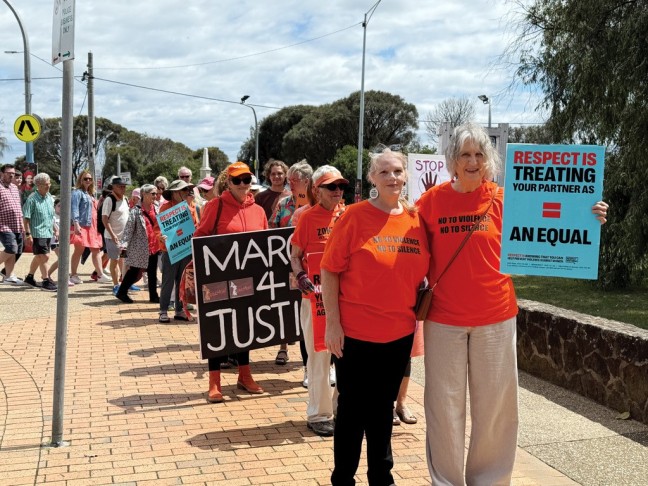
It is a volunteer-run charity established in 1996 by a group of like‑minded women living on the Mornington Peninsula to increase women’s involvement in community decision-making, and empower them to take action to address social justice and equity concerns.
The charity provides an apolitical forum for women across generations to discuss and learn about human rights and justice issues in a safe and supportive space. Importantly, it provides opportunities for those who feel isolated or are new to the region to meet, socialise and form enduring friendships.
Meetings and events
SWAN hosts a range of volunteer-run events, including five general meetings a year, as well as workshops and public forums. General meetings are an opportunity to hear stimulating presentations from inspiring female guest speakers.
Public forums provide an opportunity to learn, engage and advocate. Past forums include the ‘Housing Justice Roundtables’ and ‘Debunking Myths about Islamic Culture: A Fashion Parade – Challenging racial prejudice and discrimination’.
Advocacy and action
Members are supported to volunteer, raise community awareness about local and more wide-scale equity and justice concerns, and to advocate for change.
Since its inception, members have worked together to tackle local issues – including homelessness, racism, environmental degradation and gender‑based violence – and have vigorously advocated for the human rights concerns of Aboriginal and Torres Strait Islander people, and of refugees.
Bursaries and awards
SWAN has helped countless women pursue their own social justice journeys through:
- providing small grants to enable local students to increase confidence and public engagement skills
- helping Aboriginal tertiary students gain qualifications to pursue their chosen career
- supporting disadvantaged students to complete studies, focused on human rights and social justice issues.
In 2024, SWAN launched the ‘Val McKenna Young Women’s Advocacy Award’, a bursary for local senior state secondary students. It recognises one of the pioneering women who founded SWAN, and who was instrumental in leading a local campaign that, in 2006, contributed to significant domestic violence homicide law reform in Victoria.
The power of volunteering
The charity has a long history of supporting vulnerable people and bringing attention to issues that affect women across the world. This would not be possible without the work of volunteers.
SWAN Facilitator Diane McDonald said:
‘Volunteers are our lifeblood. Whilst it can be challenging navigating busy schedules and time constraints among our team, we’re so fortunate to be fuelled by a passionate group of women who care deeply about investing their time in making a difference.
Without people willing to donate their time and talents to achieve SWAN’s purpose, we couldn’t have provided such a wide range of opportunities for women to engage, learn and play a role in building a better world, and achieve lasting benefits for our community. But without doubt, as volunteers, we gain more than we give.’
The most common activity for volunteer-run charities was related to religion and faith‑based spirituality, which is consistent with there being many small local parishes which are most often volunteer-run.
Education was the second most common activity, reflecting the significant number of volunteer‑run Parents and Citizens associations.
Volunteer-run charities were much more likely to engage in arts and culture (for example, smaller musical or performance organisations, or cultural foundations), or in activities related to animal welfare, than non volunteer‑run charities.
For example, 3.5% of volunteer‑run charities engaged in an animal welfare activity, compared to 0.9% for non volunteer‑run charities.
Table 3: Most common activity classifications
| Activity classifications | Volunteer-run charities | Non volunteer-run charities |
|---|---|---|
| Most common | Religion and faith-based spirituality (22.9%) | Religion and faith-based spirituality (18.8%) |
| 2nd most common | Education (13.8%) | Human services (18.3%) |
| 3rd most common | Human services (11.6%) | Education (15.8%) |
| 4th most common | Health (10.9%) | Health (11.6%) |
| 5th most common | Arts and culture (10.2%) | Community development (9.4%) |
Table 4: Largest differences in activity classifications
| Activity classifications | % Volunteer-run charities | % Non volunteer-run charities |
|---|---|---|
| Human services | 11.6 | 18.3 |
| Religion and faith-based spirituality | 22.9 | 18.8 |
| Arts and culture | 10.2 | 6.8 |
| Animal welfare | 3.5 | 0.9 |
| Education | 13.8 | 15.8 |
Financial terms used in this report
- Revenue – income a charity receives when undertaking its ordinary activities (for example, donations and bequests).
- Expenses – costs a charity incurs (for example, rent or employee expenses).
- Assets – resources a charity controls such as cash, shares, property, equipment and trademarks.
- Liabilities – amounts that a charity owes such as those owed to suppliers or creditors, loans and employee entitlements.
- Ratio – we use a ratio to measure how much bigger the non volunteer‑run charities group is compare to volunteer-run charities.
While volunteer-run charities represented 43% of the sector, they generated less than 2% of the sector’s total revenue.
On average, each volunteer‑run charity reported $222,00 in revenue. In comparison, each non volunteer-run charity reported average revenue of $8.5 million – a figure 38 times more than a volunteer-run charity.
Compared to non volunteer-run charities, volunteer-run charities were much more reliant on revenue generated by donations and bequests, as well as that generated through investments (such as bank interest).
Volunteer-run charities received only 11% of their revenue from government sources, compared to a 49% share for non volunteer‑run charities. This may be due to various factors such as:
- volunteers having limited time to meet the administrative and reporting requirements for government grants
- volunteers and volunteer-run charities having less awareness of, or and ability to navigate, the government funding landscape (especially beyond smaller locally based grants)
- volunteer-run charities not needing government funding, or not applying because they do not meet government eligibility criteria.
Larger charities can often access government funding programs more easily because they have greater capacity to apply, and more resources with which to manage funds and track outcomes.
Table 5: Total amounts reported by volunteer-run charities
| Financial element | $ Amount reported by volunteer-run charities | % Contribution to total revenue for the charity sector |
|---|---|---|
| Total revenue | 4,296,829,031 | 1.9 |
| Total expenses | 3,417,688,797 | 1.6 |
| Total assets | 21,450,341,141 | 4.4 |
| Total liabilities | 3,399,668,693 | 2.0 |
Table 6: Average amounts reported by volunteer-run and non volunteer-run charities
| Financial element | $ Average amount for volunteer-run charities | $ Average amount for non volunteer-run charities | Ratio |
|---|---|---|---|
| Total revenue | 222,691 | 8,510,207 | 38.2 |
| Total expenses | 177,128 | 8,163,817 | 46.1 |
| Total assets | 1,111,705 | 18,269,103 | 16.4 |
| Total liabilities | 176,194 | 6,518,590 | 37.0 |
Table 7: Total and average amounts reported for certain revenue types
| Revenue elements reported | $ Total amount reported by volunteer-run charities | $ Average amount reported by volunteer-run charities | $ Average amount reported by non volunteer-run charities only sectors | Ratio |
|---|---|---|---|---|
| From government | 485,495,967 | 25,162 | 4,181,789 | 166.2 |
| From donations and bequests | 1,928,861,439 | 99,967 | 471,674* | 4.7 |
* A one‑off donation of $4.9 billion to the Minderoo Foundation has been excluded from this analysis in order to provide a more accurate comparison and ensure figures in this sub‑report are not skewed. More details about donations can be found in the Australian Charities Report 11th edition.
Table 8: Reliance on different sources of revenue
| Proportion of revenue element to total revenue | % Volunteer-run charities | % Non volunteer-run charities |
|---|---|---|
| Government (including grants) | 11.3 | 49.1 |
| Donations and bequests | 44.9 | 7.8 |
| Goods or services | 23.1 | 33.5 |
| Investments | 12.6 | 3.2 |
| Other revenue | 8.1 | 6.4 |
Other reporting obligations for volunteer-run charities based on different charity types
Charities established as incorporated associations under state or territory legislation represent a significant segment of the charity sector. Some 38.5% of 2023 Annual Information Statements were submitted by incorporated associations.
A significant percentage of these associations (48.4%) are volunteer‑run, with Queensland and New South Wales having the highest proportion of volunteer‑run incorporated associations.
Table 9: Volunteer-run charities by type
| Type of charity | Other regulator | % Volunteer-run charities |
|---|---|---|
| Incorporated associations | State or territory regulator | 48.4 |
| Charities that fundraise | State or territory regulator | 38.1 |
Notes:
Incorporated associations - data is based on charities that voluntarily provided us with an incorporated association number.
Charities that fundraise – data is based on charities that voluntarily provided us with a fundraising licence number. Not all charities that fundraise are required to have a fundraising licence – depending on where a charity undertakes fundraising activities, it may be exempt from the requirement to hold a fundraising licence.
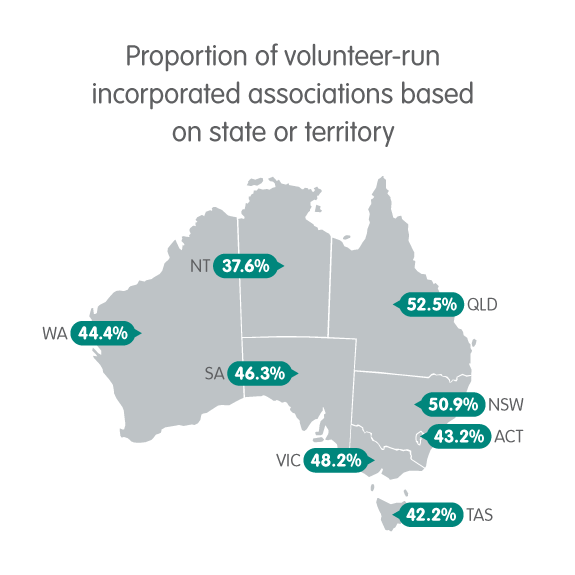
Proportion of volunteer-run incorporated associations based on state or territory
- ACT: 43.2%
- NSW: 50.9%
- NT: 37.6%
- QLD: 52.5%
- SA: 46.3%
- TAS: 42.2%
- VIC: 48.2%
- WA: 44.4%
Clean Up Australia (CUA) inspires and mobilises communities to improve and conserve the environment, eliminate litter and end waste.
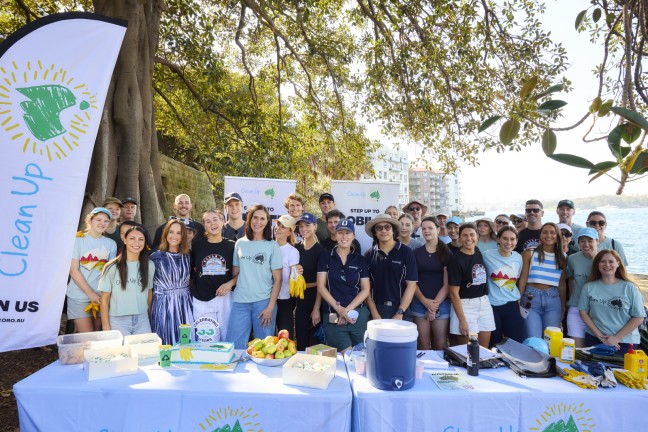
What started as a simple idea from an ‘average Australian’ wanting to make a difference in his own backyard has now grown to become the nation’s largest community-based environmental event.
It’s hard to believe that this initiative was the inspiration of one man, Ian Kiernan AO. An avid sailor, Ian was shocked and disgusted by the pollution and rubbish that he encountered in the world’s oceans.
Taking matters into his own hands in 1989, he organised a community event called ‘Clean Up Sydney Harbour’.
He expected just a few hundred volunteers. Instead, 40,000 people showed up, sparking a national movement.
And so it was that Clean Up Australia Day was born in 1990.
Over the last 35 years, more than 23 million Aussies have participated in Clean Up Australia activities and events. Their volunteers participate in practical action to remove accumulated litter from the environment, both on Clean Up Australia Day and at other times throughout the year. As well as volunteers, it operates with 10 paid staff.
They are one of Australia’s most recognised environmental charities, with the clean ups they drive playing an important role in maintaining healthy and sustainable ecosystems, while supporting social wellbeing and a sense of pride within the community.
CUA also educates on issues of waste and empowers communities to engage in sustainable behaviours to prevent waste, including avoidance, reduction and improved recycling.
Volunteer impact
More than 23 million volunteers have donated in excess of 46 million hours to their local communities, removing hundreds of thousands of ute loads of litter from more than 261,000 locations across the country.
With more 130,000 tonnes of plastic pollution leaking into the marine environment in Australia every year, the work of Clean Up Australia volunteers is invaluable.
The CUA Litter Report FY24 found plastics represented 81% of all litter in our national parks, streets, bushlands and waterways. Every bit of effort in litter removal makes a big difference. What has become clear is the need for waste prevention efforts at the design, use and disposal stages, to prevent resources from being wasted in landfill or entering our environment as litter.
Setting volunteers up for success
Clean Up Australia is unique in that volunteer numbers continue to grow. It strives to keep volunteers engaged year-round by providing free kits to support Clean Up efforts, alongside clear information and resources.
This year, volunteers were celebrated with the inaugural Community Awards Ceremony held at Parliament House.
The awards recognised the ongoing commitment and environmental stewardship of individual volunteers, community groups, education champions and councils across Australia over decades of community action.
CUA believes recognising volunteer efforts is key to sustainable volunteer engagement.
Note: Clean Up Australia has a small number of paid staff, but is included as a case study as it is the charity with the reported highest number of volunteers in recent data.
The Annual Information Statement
This report is based on the 52,627 Annual Information Statements submitted by charities for the 2023 reporting period. The Annual Information Statement collects information about a charity’s programs, operations (including people) and finances.
Citation
Charity by numbers: The volunteer effect, Australian Charities and Not‑for‑profits Commission (2025).
Further information
Further information can be found in the Data Sources section of the 11th edition of Australian Charities Report.