

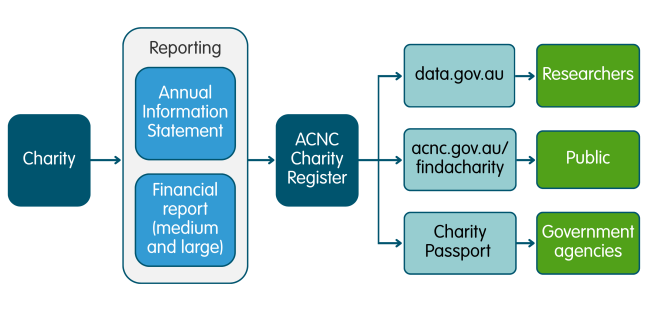
The ACNC Charity Passport is a free resource that allows authorised government agencies to access charity data that the ACNC holds.
By allowing agencies to access charity data directly from the ACNC, the Charity Passport reduces the amount of information that charities must provide to different government agencies.
This reduces red tape and administrative burdens for charities in line with the ACNC’s ‘report once, use often’ reporting framework.
Sources of information in the Charity Passport
The Charity Passport includes publicly available charity information, including financial data. Information in the Charity Passport is drawn from the data that charities provide us through:
- their ACNC registration application form
- their completed ACNC Annual Information Statements
- other updated information they notify us about – for example, changes to charity contact details, Responsible People or governing document).
Key information contained in the Charity Passport
The Charity Passport includes the following information about registered charities:
- baseline charity details including name, ABN, Address For Service, email, telephone number and website
- Responsible People
- registration status and history
- charity subtype status and history
- beneficiaries
- charity size (based on annual revenue)
- financial year
- operating locations
- Annual Information Statements, and
- enforcement outcomes.
The Charity Passport also includes financial information for all charities that have submitted an Annual Information Statement from 2014 onwards. Some information featured in the Charity Passport can also be accessed at data.gov.au.
Privacy and security
Currently, the Charity Passport does not include information that has been withheld from the Charity Register.
Information available through the Charity Passport is securely stored and made available only to authorised government agencies. The integrity of the data we hold is also protected by legislation and administrative processes.
Use of the Charity Passport is subject to both the Privacy Act 1988 (Cth) and the secrecy provisions in Part 7-1 of the Australian Charities and Not-for-profits Commission Act 2012 (Cth) (the ACNC Act).
We will only disclose charity information – and authorised government agencies can only access and use charity information – in accordance with those laws.
For more information, see our privacy policy.
We may be able to give restricted access to withheld information to authorised government agencies on request, and under certain conditions.
How government agencies can access the Charity Passport
We can provide Charity Passport access to another Australian government agency for the purposes of the ACNC Act, such as the reduction of unnecessary regulatory obligations.
The agency must request a user account by emailing redtapereduction@acnc.gov.au.
Once Charity Passport access is granted, the agency can download or copy the files across to its system. The data is listed by Australian Business Number (ABN), which allows it to be filtered and matched.
The Charity Passport and Commonwealth grants
The Charity Passport supports the Commonwealth Grants Rules and Guidelines (CGRGs), which require that:
- Commonwealth officials must have regard to information collected and made available by regulators (such as the ACNC) and should not seek this information from grant applicants/recipients, and
- if an organisation has provided a regulator with an audited financial statement, an audited financial acquittal should not be required, unless the grant is higher risk (under the CGRG Resource Management Guidance).
When government agencies request information, a charity may direct the agency to us to obtain any information, governing documents or financial reports it has already provided to us. However, processes across government agencies – including the degree to which they use information from other regulators – vary.