

The ACNC Annual Report 2024-25 provides an overview of the Commission's work in the 2024-25 financial year.
You can download a copy of our Annual Report as a PDF, or you can read it here in full.
Our year in review

I am delighted to present the 2024–25 Australian Charities and Not‑for‑profits Commission (ACNC) Annual Report.
Our work, as presented in this annual report, needs to be seen in the context of the size, breadth and contribution that ACNC registered charities make to the Australian community and overseas. To support that contribution, we aim to be a world class regulator that also works with others on ways to reduce red tape.
Our mindset is to ensure our Charity Register is accurate because, with 2.1 million searches this year (up 8%), we know it’s a powerful tool that informs safe giving and volunteering, both of which go to the sustainability of the sector.
Underpinning the Register is our work to ensure the principles‑based ACNC Governance Standards are understood and applied by those who run charities. This promotes charities being ‘governed for good’.
Providing the public with trust and confidence in Australian charities is what the ACNC team works to achieve; it’s what ties all our work together.
I highlight key aspects of our work here, and encourage you to also consider delving into our rich data using the Data Explorer on our website.
Sharing our data to better understand the sector
Our Australian Charities Report (11th edition, 2025) is used by policy makers, researchers, grant‑makers and the sector itself.
The report demonstrates the significant contribution the sector made. Our analysis of information from over 52,000 charities showed the sector employed 1.54 million people or 10.7% of Australia’s workforce.
Pleasingly volunteer numbers rose to around 3.77 million, and sector revenue reached a record high of $222 billion, growing at a greater rate than the $212 billion sector expenses.
However, aside from the largest single donation we have ever recorded – $4.9 billion to the Minderoo Foundation Group – donations flatlined.
We engaged with media, the sector and government to explain the nuance from this data. The rebound in revenue was not uniform, with smaller charities proportionally doing less well on key financial indicators. For example, extra small charities made up over 30% of the sector but generated only 0.1% of total revenue.
Meeting increased demand
It was pleasing to see that we effectively managed extra demand for our services, largely meeting all our service standards and boosting our investigations and other compliance work.
The number of charities registered rose significantly, with 4,621 new charities registered – the highest number in any year since our establishment in 2012.
More than half of all registration applications flowed from changes to the reporting by not‑for‑profits (NFPs) that have self‑assessed as income tax exempt.
To promote a streamlined bulk registration process and share guidance on the new requirements, we met with over 80 NFP peak bodies.
We registered 86% of charities (3,994 charities) within 15 business days of receiving all information necessary to make a decision about their application – close to the 90% target. This was a significant improvement on the previous year when we registered 74% of charities within the 15-day target.
The number of concerns about charities increased. We received concerns about 1,640 charities, up from 1,350 in the previous financial year. This included what appeared to be coordinated efforts by groups of people lodging similar concerns using a template format.
Reporting – the backbone of transparency
As of 30 June 2025, 73.4% of charities submitted their 2024 Annual Information Statement on time, compared to 72.5% in the previous year. The overall reporting rate is 97% for the 2023 Annual Information Statement.
As part of our continuous improvement, we worked with the Australian Centre for Evaluation to trial the impact of sending an additional reminder to a Responsible Person. The full report has been published by the Australian Centre for Evaluation.
Engaging with the sector and other regulators
In line with our sector engagement strategy, we contributed to key sector meetings and forums and held our own.
Hundreds attended our annual Regulators Day in August 2024, including sector advisers, government policy makers and charities – many joining online from rural and regional areas. Among the speakers were the Federal Minister, state and territory regulators, Australia’s Privacy Commissioner, the CEO of the Charity Commission of England and Wales and senior ACNC leaders. We use feedback from these events to improve future forums.
Highlights of 2024–25 included trips to the Northern Territory, South Australia and Tasmania where I spoke at flagship sector events, met local regulators and visited a range of charities to hear about the issues important to them.
Our engagement with others in the regulatory ecosystem at all levels of government and internationally improves our knowledge of modern regulatory practices. It enables us to work together when concerns cross jurisdictions.
There have been excellent examples of collaboration with specialist regulators on key issues like cyber security and privacy to improve guidance and raise awareness.
I had the honour of meeting charity regulators from eight nations hosted by the Charity Commission of England and Wales. It was a rich discussion across all aspects of our work. We continue to meet quarterly online.
Promoting understanding about advocacy
Before the federal election we updated our guidance and ran a communications campaign to promote awareness about charity advocacy rules.
We received 63 political advocacy concerns about 18 charities, considerably lower than the 445 concerns about 38 charities made prior to the previous federal election in 2022.
Significant compliance work
There is a high level of public interest in maintaining accountability and transparency in the charity sector.
Provisions in the ACNC Act nearly always prevent us from making disclosures about our regulatory work with particular charities. However, when we use an enforcement power, we can publish details on the charity’s record on the Charity Register.
This year we announced an enforceable undertaking entered into with Hillsong College Limited – an agreement with the charity about future conduct.
While revocation is an outcome the ACNC rarely seeks, this year we worked with other agencies to address significant concerns about the management of Brindabella Christian College by Brindabella Christian Education Limited, and that did result in revocation. In this instance the public statement about our investigation was an example of how we will act firmly where there is evidence of serious mismanagement or misappropriation of charity assets. Importantly the school continues to operate for students and families in that community – with new management and controls in place.
We published key findings of a compliance review into charities’ management of safeguarding risk, defined as protecting the welfare of people connected with a charity or its work. Reviews help us better understand specific risks and to improve our guidance offering on those topics.
Key court decision about ‘Public Benevolent Institution’
This year a judgment was handed down by the Full Court of the Federal Court, on Equality Australia Limited’s appeal regarding its eligibility to be registered with the subtype of ‘Public Benevolent Institution’.
Some elements of charity law are not well defined, and we welcomed judicial consideration of this matter. We published a Decision Impact Statement about the case in July 2025.
Ex officio Advisory Board appointments
Six new state and territory ex officio members of the ACNC Advisory Board were announced in February. These appointments provide an excellent opportunity to build on our established collaborative approach with state and territory colleagues on cross‑jurisdictional issues.
In closing, I would like to thank ACNC Advisory Board members for their wise counsel and readiness to bring the voice of the sector to the table. A special thanks to Chair, Sarah Davies AM.
My thanks also to our Sector and Adviser Forum members, who provided great insights to assist in refining our guidance and practices.
Finally, to my staff, thank you for always striving to improve. I know you are all committed to supporting a vibrant and transparent sector.
Warm regards,

Sue Woodward AM
ACNC Commissioner

It is my pleasure to provide an introduction to the 2024–25 ACNC Annual Report on behalf of the Advisory Board.
Over the past year, we welcomed Nick Maisey to the Advisory Board. Nick has a wealth of expertise across the charity and not‑for‑profit sector in social entrepreneurship and youth advocacy.
Sara Harrup stepped into the role of Deputy Chair, replacing Heather Watson. On behalf of the Board, I would like to thank Heather for her careful and professional guidance, and the significant contribution she has made to the Board.
Most of the current Advisory Board members have now celebrated our one‑year anniversary together. So, the training wheels are off for us, and we are united in our vision to understand the key challenges facing the sector, and how we can best respond.
We were fortunate to have six new ex officio members join us over the course of the 2024–25 financial year.
Collectively, we function to support a robust and thriving charity sector and our discussions have focused on ensuring the ACNC continues to meet the needs of government and the charity sector in a rapidly evolving environment.
One topic that dominated much of the Board’s focus was the updated requirements of the ATO for not‑for‑profits to self‑assess their eligibility for income tax exemptions (SAITE).
These new requirements resulted in a significant growth in new registration applications. To meet demand, the ACNC streamlined systems and processes to help charities understand and comply with the changes.
The Advisory Board spent a lot of time discussing the changes, and we will continue to keep our eye on the sector and how it responds to these reforms in the coming year.
Board conversations also pointed to the benefits of our strengthening ties with both our global counterparts, and state and territory colleagues.
Maintaining regular dialogue with our colleagues supports a diversity of perspectives and greater regulatory coordination; both of which serve charities and not‑for‑profits well.
If you are looking to get an insight into how precious and incredibly important the charity sector is, I’d encourage you to read through the ACNC’s recently released 11th Australian Charities Report. There is plenty of data here to consider; not least the statistic that charities continue to be a key driver of the economy, despite the cost‑of‑living crisis we are experiencing.
Charities provide such a broad range of services across almost every part of the economy, despite operating in challenging and ever‑changing circumstances.
Earlier this year the Advisory Board explored the potential longer‑term evolution of the ACNC, as we reflected on our Charter, role, contribution and experience. We identified several key themes for exploration to ensure the ACNC continues to serve the needs and expectations of charities and the community.
These include:
- opportunities to build public trust through earlier intervention
- strengthening engagement to support a vibrant sector
- reducing red tape and regulatory burden.
Conversations around these issues will continue to feature in Advisory Board meetings in the future.
Finally, I would like to thank all Advisory Board members for their continued commitment to the sector, and their generosity in sharing such a depth of information and expertise about charities.
Thank you also to the ACNC staff for their dedication to the cause, and Commissioner Sue Woodward AM, whose tireless and inspired leadership ensures the ACNC continues to be a world‑class regulator.
I look forward to continuing to strive to ‘do good’ for Australia’s charity sector in the coming year.

Sarah Davies AM
Chair, ACNC Advisory Board
The ACNC
The ACNC is established under the Australian Charities and Not‑for‑profits Commission Act 2012 (Cth) (the ACNC Act) as the independent national regulator of charities.
The ACNC is led by the Commissioner, a statutory office holder. The statutory functions and regulatory powers of the ACNC Commissioner are set out in the ACNC Act, the Charities Act 2013 (Cth) (the Charities Act) and accompanying regulations. The ACNC is supported by staff provided by the Commissioner of Taxation.
Sue Woodward AM was appointed to the role of Commissioner on 12 December 2022.
The ACNC Act has three objects:
- to maintain, protect and enhance public trust and confidence in the Australian not‑for‑profit sector
- to support and sustain a robust, vibrant, independent and innovative Australian not‑for‑profit sector
- to promote the reduction of unnecessary regulatory obligations on the Australian not‑for‑profit sector.
Although the ACNC Act refers to the not‑for‑profit sector, the ACNC’s remit is limited to charities.
Our purpose, vision, mission and priorities
The Commissioner sets the ACNC's direction and priorities.

Vision: Charities that inspire confidence and respect.
Mission: Promote confidence in charities; help charities to understand their obligations; support the health of the sector; streamline reporting and reduce red tape.
Priorities: Priority 1 - The Charity Register; Priority 2 - Supporting charities and building capability; Priority 3 - Using our data to maximum effect; Priority 4 - Organisational capability.
Our values are fairness, accountability, independence, integrity and respect. These values align with the Australian Public Service values and underpin the way we perform our work.
What we do
The ACNC is responsible for maintaining a public register of Australian charities (the Charity Register).
The Charity Register – our key means of promoting trust and confidence in Australia’s charities – contains key information of around 64,000 charities.
To ensure the Charity Register can be relied upon by the public, government, funders and other charities, we:
- register new charities
- support charities to ensure the Charity Register contains accurate information
- maintain the integrity of the Charity Register through:
- reviews of entitlement to charity registration of deductible gift recipient endorsed charities
- compliance and enforcement activities, and
- other integrity work (such as removing those who persistently fail to meet their reporting obligations via our double defaulter process).
We help charities to understand and meet their obligations through information, guidance, advice and other support.
We share our data with all levels of government to help them understand the impact of proposed reforms on the charity sector and to reduce the regulatory burden on charities. We also use our data to inform public policy makers, researchers, and the media about the work of the charity sector through submissions, reports and advice.
How we measure our performance
For the purposes of the Public Governance, Performance and Accountability Act 2013 (PGPA Act), the ACNC forms part of the Australian Taxation Office listed entity.
The ACNC is listed as program 1.4 of the Australian Taxation Office listed entity’s Portfolio Budget Statements (PBS).
We measure our performance through 18 key performance indicators (KPIs). Of the 18 KPIs, two are listed as performance measures in the PBS:
- Percentage of time that the Charity Register is available (excluding scheduled maintenance)
- Percentage of new eligible charities registered within 15 business days of ACNC receiving all information necessary to make a decision.
Our annual report includes analysis against all 18 KPIs. Our performance against the two PBS measures is also published in the Commissioner of Taxation’s annual report.
Sue Woodward AM, ACNC Commissioner
Sue Woodward AM started as ACNC Commissioner on 12 December 2022. Previously, she was Chief Adviser for Not‑for‑profit Law with the charity Justice Connect.
Sue was awarded a Member of the Order of Australia in 2021 for “significant service to the not‑for‑profit sector, fundraising and the law.”
She played an instrumental role in the formation of the ACNC, serving as the inaugural Director of Policy and Education during the early years of the Commission.
As an academic at Melbourne Law School, she made a seminal contribution to reforming charity and not‑for‑profit sector regulation with her 2004 research report: ‘A Better Framework: reforming not‑for‑profit regulation.’
Sue also had extensive experience as a volunteer charity board member, including sitting on the boards of the Victorian Council of Social Service, the Human Rights Law Centre, the Australian Communities Foundation and SANE Australia.
Additionally, Sue came to the ACNC as a well‑respected advocate for reducing unnecessary regulatory obligations on the sector, having led an alliance of peak bodies and worked with federal and state governments to make modernised and harmonised fundraising laws a priority.
Natasha Sekulic, Assistant Commissioner – General Counsel and Regulatory Services

Natasha is the senior legal adviser to the ACNC Commissioner and Advisory Board and contributes to corporate and strategic leadership as a member of the Executive team.
At the Australian Taxation Office, Natasha has worked in a range of leadership roles including most recently as Service Delivery Director. Taxation law, charity law and government administration have been central to a range of executive level roles.
Previously at the ACNC, Natasha served as a lawyer and later as Acting Director Legal and Policy. She has been a volunteer and board member for several charities.
She is admitted to practice law and holds a Bachelor of Laws, a Bachelor of Arts, a Graduate Diploma of Legal Practice and a Master of Taxation.
Cate Bennett, Assistant Commissioner – Operations and Engagement

Cate is an experienced executive leader, having worked in a variety of legal, commercial and corporate enablement roles across the public and not‑for‑profit sectors over the last 15 years.
Cate’s work in the public sector started as a graduate rotating in the Victorian Departments of Health, Justice and Transport. She ultimately focused on commercial legal advice roles, and contract and service delivery management for key public infrastructure and new health service developments, as well as transport services.
Her experience in the not‑for‑profit sector includes working at Beyond Blue, and with the board of the Leukaemia Foundation on a pro bono basis. She served as the Global General Counsel and Company Secretary at Movember, which involved working with a large number of local and international regulators.
Cate is a qualified lawyer, who holds a Bachelor of Laws (Hons) and a Bachelor of Business. She is an alum of the Stanford Graduate School of Business and has twice been named the Not‑for‑Profit Lawyer of the Year by the Association of Corporate Counsel Australia.
The ACNC has six directorates, each of which plays an important role in helping us achieve the objects of the ACNC Act.
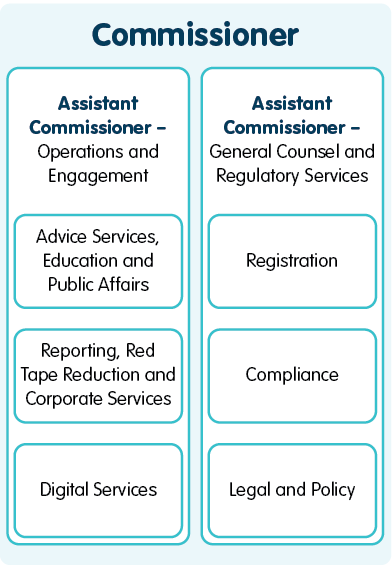
Assistant Commissioner – Operations and Engagement: Advice Services, Education and Public Affairs; Reporting, Red Tape Reduction and Corporate Services; Digital Services.
Assistant Commissioner – General Counsel and Regulatory Services: Registration; Compliance; Legal and Policy.
Advice Services, Education and Public Affairs
Our Advice Services team provides information to charities and members of the public about charity governance and obligations by responding to written and phone enquiries.
Analysis of enquiries to Advice Services helps us to identify how we can improve our services to charities, their advisers and the public.
Our Education and Public Affairs team manages internal and external communications, including delivering the latest regulatory news, managing the ACNC website, social media, and government and media relations.
The team is responsible for developing guidance and resources to help charities meet their obligations to the ACNC, promoting awareness of the work of ACNC and our Charity Register and delivering accessible information about Australia’s charity sector.
Reporting, Red Tape Reduction and Corporate Services
Our Reporting and Red Tape Reduction team administers our reporting framework and works with other government agencies to reduce red tape for charities.
The team manages the Charity Passport, oversees the design of the Annual Information Statement and works to ensure the integrity of data we collect from charities. They also undertake analysis of ACNC data, including the analysis for our annual Australian Charities Report.
Our Corporate Services team supports the ACNC in meeting staffing, financial, governance and risk obligations. The team plays a leading role in supporting a ‘One ACNC’ culture, and is responsible for implementing key strategic workforce, culture and people initiatives.
Digital Services
Our Digital Services team is responsible for ACNC information technology (IT) services, which includes managing implementation, maintenance, support and improvements to our website and business operating systems.
The team manages cyber security risks and supports IT innovation (including Artificial Intelligence and other emerging technologies). The team also provides data to support the ACNC operations, facilitating data exchanges, and publishing data which can be accessed by the public.
Registration
Our Registration team is responsible for assessing charity registration applications and reviewing charities’ continued entitlement to registration. The team helps streamline the process through which charities get access to Commonwealth charity tax concessions, such as deductible gift recipient status (DGR), by collecting necessary information and passing it onto the ATO.
The team also assesses requests from charities to have information withheld from the Charity Register, to have new charity subtypes added to their registration, and to have their registration voluntarily revoked.
Compliance
Our Compliance team works to address risks that pose a threat to trust and confidence in the charity sector in line with our regulatory approach. The team assesses and analyses concerns from a range of sources including the public, media, referrals from other regulators and government agencies, and the ACNC’s own work. They oversee the charity self‑evaluation and self‑audits program and conduct compliance reviews and investigations.
The team works with state, territory and Commonwealth regulators and law enforcement agencies to ensure information is exchanged and actions are taken in a coordinated manner.
Legal and Policy
Our Legal and Policy team provides legal advice on interpretation and application of the ACNC Act, the Charities Act and other applicable legislation and regulations. The team manages legal review and appeal proceedings of ACNC administrative decisions. It also manages obligations under the Freedom of Information Act 1982 (the FOI Act) and the Privacy Act 1988 (the Privacy Act).
The team also undertakes strategic policy work, including coordinating submissions on policy and legislative initiatives that are of relevance to charities, and the not‑for‑profit sector more broadly.
The ACNC Advisory Board is established under the ACNC Act to support and advise the ACNC Commissioner.
Under the ACNC Act, the Board is appointed by the Minister and consists of:
- up to eight general members with expertise in the not‑for‑profit sector, law, taxation or accounting, and specified office holders
- ex officio members, representing the governments of states and territories.
General members are appointed for a term of up to three years. Ex officio members remain on the Board for as long as they hold the specified office.
In 2024–25, the Assistant Minister:
- appointed Nick Maisey as a new general member
- appointed six new ex officio members.
Summaries of Advisory Board meetings are available on our website.
General members
Sarah Davies AM (Chair)
Sarah has had a wide‑ranging career from executive roles in tertiary education to private sector consulting in Australia and overseas. For over 18 years she has held leadership and executive positions in the charity and for‑purpose sector.
In 2021 Sarah joined the Alannah & Madeline Foundation as the CEO. The Foundation works to make sure children can grow up happy, safe and strong – in both their online and offline worlds – free from violence, and with the support and strategies they need to thrive.
Sarah also serves on a range of boards and committees, including Social Ventures Australia.
Sara Harrup (Deputy Chair)
Sara is a seasoned governance leader with a career in steering organisations through complex transitions and growth, particularly within the not‑for‑profit sector. She has played a pivotal role in enhancing board composition, risk management, and strategic governance across various organisations, including charities in the transport and logistics, community and health space.
Sara is also an independent member of the ACNC’s Performance, Audit and Risk Committee.
Emeritus Professor Myles McGregor-Lowndes OAM
Emeritus Professor Myles McGregor‑Lowndes OAM is the former Director of The Australian Centre of Philanthropy and Nonprofit Studies at the Queensland University of Technology. Myles was a founding member of the ATO Charities Consultative Committee and the ACNC Advisory Board.
He is an internationally recognised charity law academic and has written extensively about not‑for‑profit tax and regulation, not‑for‑profit legal entities, government grants and standard charts of accounts as a means of reducing the compliance burden. He is a practising lawyer in Queensland.
Ian Hamm
A Yorta Yorta man, Ian has extensive government and community sector experience, particularly at executive and governance levels. Ian has overseen major policy and strategic reforms for government and community organisations. He works with people from a vast array of backgrounds, managing complex and sensitive relationships to achieve mutually beneficial outcomes.
Ian chairs and is a member of several boards, including the Australian Institute of Company Directors, Inclusive Australia Limited and the Indigenous Land and Sea Corporation.
Rosa Loria
Rosa’s passion is helping culturally and linguistically diverse communities, including seniors, newly arrived migrants, refugees, people with a disability and other community members. For more than 40 years, Rosa has advocated for disadvantaged refugees and residents from multicultural backgrounds at a policy level.
A community innovator, she has helped establish many organisations and services including Sydney Multicultural Community Services, Youth Employment Support Scheme, Skill Share, Killara Women’s Refuge, Settlement Services International and The Settlement Engagement.
Anna Bacik
Anna has held leadership and senior roles in not‑for‑profits and state government agencies and membership on a range of committees and advisory boards throughout her career. Her experience includes developing and implementing policy and programs in health, community services, sector development and regulation.
She has had the privilege to work with and for communities and people from diverse backgrounds, identities and lived experiences.
David Crosbie
David is CEO of the Community Council for Australia, a role he has held for more than a decade. He has spent more than 25 years as CEO of significant not‑for‑profit organisations, including the Mental Health Council of Australia, the Alcohol and other Drugs Council of Australia, and Odyssey House Victoria.
He has served on many national advisory groups and boards including the first Advisory Board for the ACNC, the Not‑for‑Profit Sector Reform Council and the Chair of the National Compact Expert Advisory Group.
Nick Maisey
Nick is the Founder and CEO of Befriend, a vibrant community building non‑profit established in Western Australia in 2010 to address isolation and loneliness through community‑led connecting efforts.
Through Befriend’s community building projects, Nick connects with many new and emerging grassroots community groups and next‑generation charities. Nick brings experiences in social entrepreneurship, innovation, social justice, inclusion and resilience.
Ex officio members
Natasha Mann
Commissioner of Fair Trading and Deputy Secretary of Fair Trading and Regulatory Services Division in the Department of Customer Service, New South Wales.
Amanda Nobbs-Carcuro
Executive Director, Industry Capability, Licensing and Migration, Department of Trade, Business and Asian Relations, Northern Territory.
Victoria Thompson
Deputy Director‑General, Harm Prevention and Regulation, Department of Justice, Queensland.
Brett Humphrey
Commissioner for Consumer and Business Services, South Australia.
Robyn Pearce
Executive Director of Consumer, Building and Occupational Services, Department of Justice, Tasmania.
Nicole Rich
Director of Consumer Affairs and Executive Director of Regulatory Services in the Department of Government Services, Victoria.
Patricia Blake
Commissioner for Consumer Protection, Department of Energy, Mines, Industry, Regulation and Safety, Western Australia.
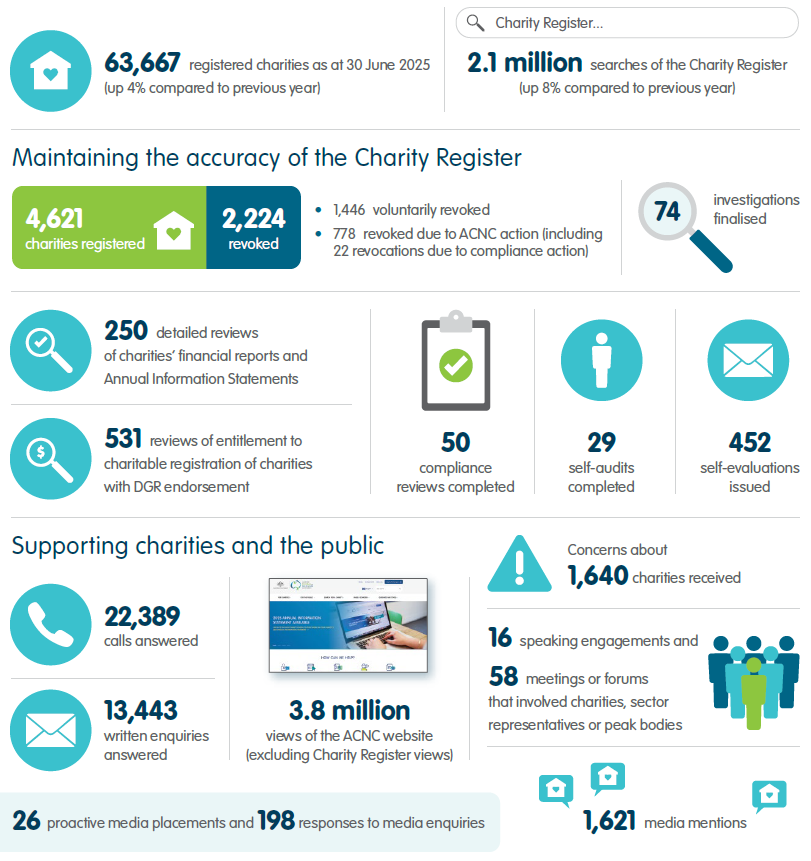
- 63,667 registered charities as at 30 June 2025 (up 4% compared to previous year)
- 2.1 million searches of the Charity Register (up 8% compared to previous year)
Maintaining the accuracy of the Charity Register
- 4,621 charities registered
- 2,224 revoked
- 1,446 voluntarily revoked
- 778 revoked due to ACNC action (including 22 revocations due to compliance action)
- 74 investigations finalised
- 250 detailed reviews of charities' financial reports and Annual Information Statements
- 531 reviews of entitlement to charitable registration of charities with DGR endorsement
- 50 compliance reviews completed
- 29 self-audits completed
- 452 self-evaluations issued
Supporting charities and the public
- 22,389 calls answered
- 13,443 written enquiries answered
- 3.8 million views of the ACNC website (excluding Charity Register views)
- Concerns about 1,640 charities received
- 16 speaking engagements and 58 meetings or forums that involved charities, sector representatives or peak bodies
- 26 proactive media placements and 198 responses to media enquiries
- 1,621 media mentions
New guidance/support | Updated guidance |
|---|---|
| Interactive charity registration self-assessment tool | Charity advocacy |
| Using artificial intelligence | Guidance relating to the self-assessing income tax exempt reforms |
| Four de-identified registration decision summaries | Safeguarding |
| Webinar: Reporting to the ACNC for the first time | Data and privacy |
| Webinar: Information for charities operating overseas | Governing Charities online learning, including:
|
| Podcast: Charities and privacy | Record-keeping |
| 2024 Annual Information Statement Guide and Hub | Minutes and meeting minutes template |
| Template: Internal dispute resolution and disciplinary procedures | Handover notes |
| Managing people's information and data with the Office of the Australian Information Commissioner (OAIC) |
Using our data to maximum effect
- 3,428 automated IT 'reports' that provide other government agencies with ACNC data (IT reports often include more than one dataset)
- Australian Charities Report 11th edition
Submissions into government reforms and inquiries
- Senate Economics References Committee inquiry on ‘Not-for-profit entities – Tax assessment’
- Senate Economics Legislation Committee inquiry into the Treasury Laws Amendment (Build to Rent) Bill 2024 and the Capital Works (Build to Rent Misuse Tax) Bill 2024
- Australian Accounting Standard Board in relation to proposed financial reporting framework for the not-for-profit sector
- Victorian Gambling and Casino Control Commission in relation to the bingo sector
- Independent Review of the Australian Small Business and Family Enterprise Ombudsman
As a regulator, our aim is to promote public trust and confidence in Australia’s charities.
We recognise that charities have a key role in enhancing social capital and connectedness in Australian communities. We also recognise that the public provides significant support to charities through the donation of time, skills and money.
We regulate charities in accordance with:
- our Regulatory Approach Statement
- the Statement of Expectations issued by the Assistant Minister for Productivity, Competition, Charities and Treasury and our corresponding Statement of Intent
- the three Regulator Operating Principles (a set of principles that all regulators must report against).
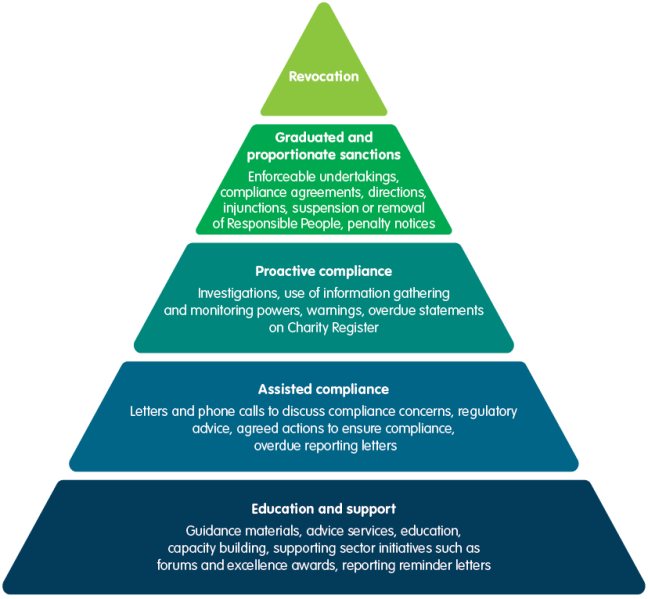
Graduated and proportionate sanctions: Enforceable undertakings, compliance agreements, directions, injunctions, suspension or removal of Responsible People, penalty notices.
Proactive compliance: Investigations, use of information gathering
and monitoring powers, warnings, overdue statements on Charity Register.
Assisted compliance: Letters and phone calls to discuss compliance concerns, regulatory advice, agreed actions to ensure compliance, overdue reporting letters.
Education and support: Guidance materials, advice services, education, capacity building, supporting sector initiatives such as forums and excellence awards, reporting reminder letters.
ACNC Regulatory Pyramid
Our regulatory pyramid highlights our approach to regulation. While most of our efforts are focused on education and support, we will use other compliance powers based on the seriousness of the offence, or risk to public trust and confidence.
This ensures that we:
- effectively target key issues that have the greatest impact on public trust and confidence
- maximise charities’ voluntary compliance with our obligations.
Case study
Our new registration application form
In June 2024, we launched our new registration application form after extensive engagement with the sector and advisers.
When developing the new form, we analysed previous applications to identify areas where applicants often provided incomplete information which often led to the application being withdrawn or refused (because of the lack of information).
The new form was designed to help streamline the application process and included more embedded guidance to support applicants to provide all the required information upfront.
Our data shows the new form has decreased:
- the proportion of withdrawn applications from 9% in 2023–24 to 6% this year
- the proportion of applications refused due to insufficient information from 28% to 20%.
Although we embedded additional guidance in the form, the number of applicants that found the form difficult increased from 7% to 13%. The new form included additional questions (to ensure all necessary information is obtained), which may have contributed to this increase.
We continue to review the guidance in the form and on our website to identify further opportunities to support applicants when submitting the application form.
Regulator operating principles
The Australian Government has established three principles of regulator best practice:
- Continuous improvement and building trust: regulators adopt a whole‑of‑system perspective, continuously improving their performance, capability and culture to build trust and confidence in Australia’s regulatory settings.
- Risk‑based and data driven: regulators manage risks proportionately and maintain essential safeguards while minimising regulatory burden and leveraging data and digital technology to support those they regulate to comply and grow.
- Collaboration and engagement: regulators are transparent and responsive communicators, implementing regulations in a modern and collaborative way.
Table 1: Operating principles related to key performance indicators
We have embedded the three regulator operating principles into everything we do, including our key performance indicators.
Indicator | Operating principles | ||
|---|---|---|---|
| Continuous improvement and building trust | Risk‑based and data driven | Collaboration and engagement | |
| 1.1 Percentage of time that the Charity Register is available (excluding scheduled maintenance) | Tick icon | Tick icon | Tick icon |
| 1.2 Percentage of new eligible charities registered within 15 business days of ACNC receiving all information necessary to make a decision | Tick icon | Tick icon | Tick icon |
| 1.3 Percentage of [2024] Annual Information Statements submitted by the due date | Tick icon | Tick icon | Tick icon |
| 1.4 Percentage of investigations finalised within 90 business days of ACNC receiving all information necessary to make a decision | Tick icon | Tick icon | Tick icon |
| 1.5 When a charity is notified of an investigation, the percentage of investigations that result in a regulatory action | Tick icon | Tick icon | Tick icon |
| 1.6 Percentage of DGR endorsed charities reviewed to confirm eligibility of subtype and registration | Tick icon | Tick icon | Tick icon |
1.7 Processing/making a decision on the following forms within 7 business days of receiving all the information:
| Tick icon | Tick icon | Tick icon |
1.8 Making a decision within 15 business days of receiving all information for the following forms:
| Tick icon | Tick icon | Tick icon |
| 2.1 Percentage of calls answered within four minutes, and percentage of written correspondence responded to within seven business days of receiving all information necessary to respond | Tick icon | Tick icon | |
| 2.2 Percentage of users that find our guidance useful | Tick icon | Tick icon | Tick icon |
| 2.3 Percentage of charity recipients that open The Charitable Purpose newsletter | Tick icon | Tick icon | |
| 2.4 Percentage of respondents satisfied with the service provided during the registration application process | Tick icon | Tick icon | |
| 2.5 Percentage of respondents that find questions in the Annual Information Statement easy to understand | Tick icon | Tick icon | Tick icon |
| 3.1 Percentage of datasets delivered to other regulators (as part of data sharing arrangements) on time | Tick icon | Tick icon | |
| 3.2 Views of the ACNC data hub | Tick icon | Tick icon | |
| 3.3 Percentage of datasets on data.gov.au updated weekly | Tick icon | Tick icon | |
| 4.1 Acknowledging a complaint about the ACNC within 3 business days and responding within 20 business days | Tick icon | Tick icon | |
| 4.2 Responding to Privacy Act requests within 30 calendar days | Tick icon | Tick icon | |
Our experience shows that the vast majority of people involved in running charities want to do the right thing.
To build their confidence – so they understand that we can provide support – we engage and collaborate extensively with charities, peak representative bodies, advisers to charities and other stakeholders who work with or regulate the charity sector.
This approach aligns with the Australian Government’s regulator operating principles, and helps the ACNC to understand specific opportunities, challenges and risks facing the sector (or different parts of the sector).
Our sector and broader public engagement also drives awareness of the role the ACNC plays, that concerns can be raised with us, and how the Charity Register can support safe giving.
Sector engagement
Collaboration and engagement with charities helps us to understand the real‑world challenges and opportunities they face, as well as the impact of our work. This helps us deliver the best possible regulatory outcomes to meet our statutory objects.
The Commissioner and senior leadership team had 16 speaking engagements and attended 58 meetings or forums that included charities, sector representatives or peak bodies.
We consulted on various pieces of guidance, including our template constitution for companies limited by guarantee, and guidance on advocacy. We also sought feedback on changes to our Commissioner’s Interpretation Statement: Public Benevolent Institutions following a Full Federal Court decision.
We continued to meet with our Adviser (professional advisers such as legal and accounting professionals) and Sector (representatives from registered charities) Forums to discuss charity regulation and seek their insights into emerging issues that affect the sector. We convened each of the forums twice, as well as hosting a combined Regulators Day (now known as the ‘Governing for Good’ Forum). Notes from these meetings are published on our website.
We thank the members of these forums for their expertise and time.
We also convened a specific forum with the non‑government school sector to better understand their operating environment, including risks and issues.
Engaging with government
We work with a range of government agencies and regulators to discuss common interests, reduce red tape and to help them understand the impact of potential reforms on the charity sector.
This year, we chaired three forums with state and territory fair trading regulators to discuss red tape reduction initiatives and share insights on emerging risks within the sector.
We also engaged with our international charity regulatory counterparts. This year, we attended four forums with international charity regulators, including a face‑to‑face meeting in October 2024.
We worked closely with government agencies on several investigations. We received 26 referrals from other government agencies and we referred 29 charities to other government agencies when we thought the other agency may be better placed to respond to an issue of concern.
We made five submissions during the year, using our data and insights to illustrate the impact of government reform on the charity sector. We provided submissions to the:
- Senate Economics References Committee inquiry on ‘Not‑for‑profit entities – Tax assessment’
- Senate Economics Legislation Committee inquiry into the Treasury Laws Amendment (Build to Rent) Bill 2024 and the Capital Works (Build to Rent Misuse Tax) Bill 2024
- Australian Accounting Standard Board in relation to proposed financial reporting framework for the not‑for‑profit sector
- Victorian Gambling and Casino Control Commission in relation to the bingo sector
- Independent Review of the Australian Small Business and Family Enterprise Ombudsman.
We also attended the Business Registry and Inter‑Agency Liaison group (chaired by an ASIC Commissioner with ATO, Treasury and other agencies represented) as part of the Australian Government’s RegistryConnect program.
As of 30 June 2025, 24 different government agencies were using the Charity Passport. This is in addition to other government agencies that choose to use our datasets on data.gov.au.
Engaging with the public
We publish guidance and use social media to help the public to better understand the charity sector. Our annual ‘Safe Giving’ campaign promotes the Charity Register and helps educate and protect donors from scams. We also assist the public with enquiries or concerns.
In 2024–25, we received concerns about 1,640 charities, an increase from 1,350 received in 2023–24. All concerns are risk assessed to determine the significance of the matter (in terms of affecting public trust and confidence) and whether it falls within our jurisdiction.
Of these concerns, 56% were from the public. We saw an increasing number of instances where many concerns were made about a particular charity in what appeared to be a coordinated effort by a group of people, often using a consistent template format. Current or former employees of charities comprise 12% of concerns, and 7% were from current or former Responsible People.
In the period leading up to an election, it is typical for the ACNC to see a rise in concerns about charity advocacy activities. In the lead up to the 2025 federal election, we received complaints about 18 charities, compared to 38 associated with the 2022 federal election.
Priorities
The Charity Register is at the heart of what we do. The public can use the Charity Register to find charities to donate to or volunteer with or to seek services from. Charities can use the Charity Register to collaborate with like‑minded organisations.
To stay on the Charity Register, charities need to meet their ongoing obligations.
As part of our ‘report‑once, use often’ framework, government agencies and grant funders can use information on the Charity Register instead of asking charities to provide this information separately.
Table 2: Results for Priority 1 key performance indicators
| Key performance indicator | Target | Result |
|---|---|---|
| 1.1 Percentage of time that the Charity Register is available (excluding scheduled maintenance) | 95% | 99.92% |
| 1.2 Percentage of new eligible charities registered within 15 business days of ACNC receiving all information necessary to make a decision | 90% | 86% |
| 1.3 Percentage of [2024] Annual Information Statements submitted by the due date | 75% | 73% |
| 1.4 Percentage of investigations finalised within 90 business days of ACNC receiving all information necessary to make a decision | 75% | 88% |
| 1.5 When a charity is notified of an investigation, the percentage of investigations that result in a regulatory action | 90% | 93% |
| 1.6 Percentage of DGR endorsed charities reviewed to confirm eligibility of subtype and registration | 2% (512) | 531 |
1.7 Processing/making a decision on the following forms within 7 business days of receiving all the information:
| 80% | 87% |
1.8 Making a decision within 15 business days of receiving all information for the following forms:
| 90% | 89% |
Criterion results grading
| Result | Description |
|---|---|
| Met | Target met or exceeded |
| Partially met | 80% or more of the target was achieved |
| Not met | Less than 80% of the target was achieved |
Case study
Supporting charitable not-for-profits affected by the introduction of the NFP self-review return by the ATO
The number of charities regulated by the ACNC continues to grow, largely due to changes to the administration of NFPs that self-assess as income tax exempt (SAITE) to the ATO.
Under the SAITE changes, if a not‑for‑profit (NFP) entity with an Australian Business Number wants to be exempt from income tax, it must:
- be registered with the ACNC as a charity if it has charitable purposes, or
- submit an annual return to the ATO if it is not charitable and fits within one of the relevant ATO categories.
While the number of NFP entities that need to be registered with the ACNC remains unknown, our data shows that:
- we received around 930 queries relating to these reforms
- at least 51% of charity registration applications we received related to the ATO’s SAITE changes.
We expect the increased number of enquiries and registration applications associated with the reforms to continue for at least the next two years while the new reporting requirement is being more fully implemented.
To manage the impacts of the SAITE changes, we have:
- developed guidance and tools, including an online charity self-assessment tool (which received over 21,000 page views) that help NFPs to identify if they are charitable
- hosted webinars to help NFPs to understand the reforms (250 attendees) and to assist newly registered charities who must report to the ACNC for the first time (407 attendees)
- reviewed and refined our processes to improve efficiency
- employed over 20 temporary staff, funded by the ATO (up to 30 June 2026) and the ACNC
- met with over 80 NFP peak bodies to promote a streamlined bulk registration process and to share guidance on the new requirements.
Analysis for each key performance indicator
1.1 Percentage of time that the Charity Register is available (excluding scheduled maintenance)
Registered charities have a free online presence on the ACNC Charity Register, which contains detailed information on around 64,000 nationally registered charities.
The Charity Register is the ACNC’s key means of promoting public trust and confidence in Australia’s charities. It is used by the public, potential donors, volunteers, government, the media, researchers and other charities.
Because of the importance of the Charity Register, we are committed to having it available as often as possible.
During the year, the Charity Register was available for 99.92% of the time.
Due to the provision of back‑office services by the ATO, the Charity Register’s availability can be affected by both ACNC and ATO issues.
In 2024–25, total unexpected downtime was around 449 minutes.
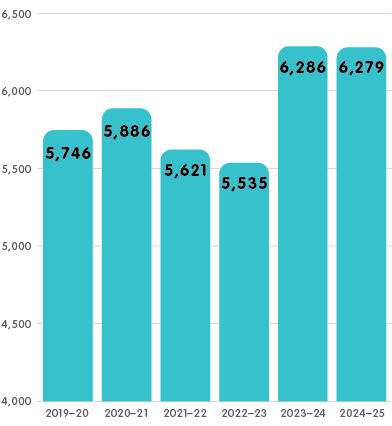
2019-20: 5,746; 2020-21: 5,886; 2021-22: 5,621; 2022-23: 5,535; 2023-24: 6,286; 2024-25: 6,279.
1.2 Percentage of new eligible charities registered within 15 business days of ACNC receiving all information necessary to make a decision
It is important for the ACNC to process new applications from eligible organisations as quickly as possible to meet community expectations and provide good customer service.
This ensures the Charity Register is accurate and to support charities wishing to access available benefits and concessions.
We registered 4,621 new charities this year, the highest number ever registered by the ACNC in any year.
We partially met our target of 90%. We registered 86% of charities (3,994 charities) within 15 business days of receiving all information necessary to make a decision. This was a significant improvement on the previous year, where we registered 74% of charities within the standard.
We continued to receive a high number of applications in 2024–25. At least 51% of our applications were due to SAITE.
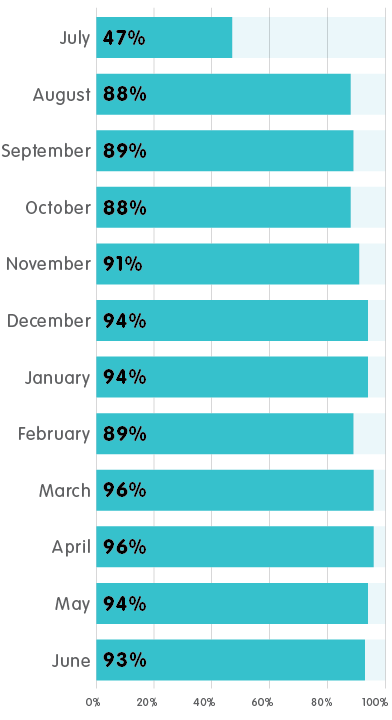
July: 47%; August: 88%; September: 89%; October: 88%; November: 91%; December: 94%; January: 94%; February: 89%; March: 96%; April: 96%; May: 94%; June: 93%.
Our overall performance across the year was impacted by our July results. In the 2023–24 annual report, we highlighted that we received 931 applications in May 2024, the highest number ever received in a month.
Despite our best efforts, some of these applications were unable to be assessed by June 2024 and were ‘carried over’ into 2024–25.
Since August 2024, the lowest monthly result has been 88%. We exceeded our target for seven months of the year.
1.3 Percentage of Annual Information Statements submitted by the due date
Each year, charities must submit an Annual Information Statement, except charities that are also registered with the Office of the Registrar of Indigenous Corporations (ORIC).
The Annual Information Statement asks for information about a charity’s programs, beneficiaries, human resources and finances. Medium and large charities must provide reviewed or audited annual financial reports with their Annual Information Statement.
Data from the Annual Information Statement updates the Charity Register, ensuring it remains accurate and a useful resource for the public. Although the Annual Information Statement is due within six months of the end of a charity’s reporting period, this deadline can be extended.
As of 30 June 2025, 73.4% of charities had submitted their 2024 Annual Information Statement by the due date (compared to 72.5% in the previous year).
We continue to trial different ways to improve on‑time submission rates. For example, we worked with the Australian Centre for Evaluation to trial the impact of sending an additional reminder to a Responsible Person. The full report has been published by the Australian Centre for Evaluation.
1.4 Percentage of investigations finalised within 90 business days of ACNC receiving all information necessary to make a decision
Investigating a charity is our most significant response to suspected non‑compliance. In line with our regulatory approach, we will begin an investigation when we identify a risk of serious and/or deliberate non‑compliance.
We are committed to finalising investigations in a timely manner. The timeliness of an investigation is affected by multiple factors, such as the complexity of the matter being investigated and the charity’s level of co-operation in providing the information we need.
Where we contact a charity as a result of an investigation, we define ‘receiving all information’ as the point where we receive a response from a charity that:
- provides sufficient evidence to demonstrate its compliance, or
- shows it has undertaken governance reforms in consultation with or as required by the ACNC, or
- responds to our show cause notice.
This year, we notified 74 charities of an investigation. Of the 74, 88% were finalised within 90 business days of the ACNC receiving all information necessary to make a decision.
1.5 When a charity is notified of an investigation, the percentage of investigations that result in a regulatory action
Regulatory actions as a result of an investigation can include education (such as advice on improving record‑keeping or financial management policies), compliance agreements (for example, an action plan about improving management practices), use of our legislative enforcement powers (such as enforceable undertakings and warnings) or revocation of charity status. Revoking a charity’s registration is the most serious step that the ACNC can take and affects a charity’s eligibility for tax concessions as well as other government benefits, concessions or exemptions.
Where a charity was notified of an investigation, 93% resulted in regulatory action.
This year, we closed 34 investigations with regulatory advice. We accepted one enforceable undertaking, issued one warning and revoked the charity status of 22 organisations. Three organisations voluntarily revoked charity status and we issued eight other regulatory actions (such as additional reporting obligations).
Of the 22 organisations that were revoked, there were eight instances of non‑compliance with Governance Standards (most commonly these related to financial management), seven instances where charities failed to meet ACNC reporting obligations, five instances where charities failed to meet record‑keeping requirements, and three instances of non‑compliance with an External Conduct Standard. Some charities were revoked for multiple breaches.
1.6 Percentage of DGR endorsed charities reviewed to confirm eligibility of subtype and charity registration
Each year, we review at least 2% of DGR endorsed charities to assess their continued eligibility for charity registration.
Our reviews are completed in two stages:
- Stage 1: We conduct an initial desktop assessment. If that initial review uncovers any issue, or if we need further information to help us make an assessment, we conduct a more detailed review.
- Stage 2: As part of a more detailed review, we will contact the charity.
Our reviews focused on DGR endorsed charities that were:
- most likely to have charity registration revoked based upon past reviews (such as charities that were non‑operational for at least 2 years or charities that had DGR endorsement as a Public Benevolent Institution, Health Promotion Charity or as a school building fund), or
- in a DGR endorsement category not previously reviewed (this included overseas aid funds, art galleries, higher education institutions and Australian disaster funds).
If we identify information that is missing from the Charity Register as part of a desktop review, we will proactively support charities to maintain the accuracy of their information on the Charity Register. For example, a charity may still be entitled to DGR endorsement but may not have provided the ACNC with the details of its current Responsible People. During our desktop review, we will support the charity to update any remaining details and ensure the Charity Register is current.
In 2024–25, we exceeded our target of reviewing 512 DGR endorsed charities, completing 531 desktop reviews.
Table 3: Outcomes of DGR endorsed charity reviews 2024–25
| Financial year | Number |
|---|---|
| No detailed review required – charity still entitled to registration and support provided to help update the Charity Register | 80 |
| Escalated for a detailed review | 163 |
| No further action required – charity entitled to subtype and charity registration | 288 |
1.7 Processing/making a decision on the following forms within 7 business days of receiving all the information:
- Form 3A – Change of Responsible Person
- Form 3B – Change of charity details
- Form 4A – Request substituted accounting period
- Form 4B – Request group reporting
- Form 4C – Bulk Annual Information Statement
- Form 4D – Apply to keep charity size
- Paper Annual Information Statement.
Charities can submit a range of forms to the ACNC.
To ensure the Charity Register is accurate, we are committed to processing the forms above within 7 business days of receiving all required information.
Form 3A – Change of Responsible Person and Form 3B – Change of charity details were the most common forms received.
Of the 2,950 forms processed this year, 87% (2,556) were processed within 7 business days of receiving all required information.
1.8 Making a decision within 15 business days of receiving all information for the following forms:
- Form 1C – Change charity subtype
- Form 1D – Request withholding
- Form 5A – Apply to revoke registration.
To maintain the accuracy of the Charity Register, charities can update their charity subtypes, request to withhold information from the Charity Register or request that the ACNC revoke charity registration.
These forms require an ACNC staff member to make a decision. For this reason, we aim to process 90% of the forms within 15 business days of receiving all information.
This year, we made a decision on 2,112 forms. Of those, 89% (1,889) were made within 15 business days of receiving all information.
Other work to maintain the accuracy of the Register
We have a program of work to ensure the Charity Register remains accurate.
Investigations (KPIs 1.3 and 1.4) and reviews of charity and subtype entitlement for DGR endorsed charities (KPI 1.6) form part of this program. Some of our other work is provided below.
Revocation of charity status
The ACNC revokes charity status of organisations that are no longer entitled to be on the Charity Register.
There are generally two types of revocations:
- Voluntary revocations – organisations can request voluntarily revocation of their charity registration for a range of reasons (for example, if they are no longer operating).
- Revocation due to ACNC action – this includes revocation of charity status following an investigation, removal of ‘double defaulters’ and organisations that have a cancelled Australian Business Number (ABN).
We classify a double defaulter as any charity that has not submitted two or more Annual Information Statements. We make numerous attempts to contact double defaulter charities and request they submit any outstanding Annual Information Statements within 28 days of the most recent correspondence being sent. If they fail to do so, we revoke their charity registration.
Organisations can also request voluntary revocation of their charity registration for a range of reasons. The proportion of voluntarily revocations due to mergers remained consistent with 2023–24.
This year, we revoked charity status for 2,224 entities:
- 778 were revoked due to ACNC action (including 22 revocations due to an investigation)
- 1,446 were voluntarily revoked.
Table 4: Voluntary revocations
| Reason for voluntary revocation | % of total 2023-24 | % of total 2024-25 |
|---|---|---|
| No longer wants to be a registered charity | 3 | 3 |
| Merged with another charity | 13 | 12 |
| No longer operating | 78 | 84 |
| Not entitled to be a charity | 7 | <1 |
100% | 100% |
Self-audits
A self‑audit requires a charity to respond to questions related to their compliance with Governance Standards and, where applicable, External Conduct Standards.
Self‑audits assess charities against five key focus areas:
- managing conflicts of interest and related party transactions
- safeguarding
- financial management
- managing risk
- working with overseas partners (where they operate overseas).
Depending on the response, we may provide tailored regulatory advice that supports charities to comply with their obligations to the ACNC.
This year, 29 charities were required to complete a self-audit:
- 11 charities had satisfactory governance
- 18 charities were provided with regulatory advice.
Compliance reviews
We use compliance reviews to better understand whether risks exist in certain parts of the sector. We share any findings through news articles, The Charitable Purpose, and by updating our guidance. Participation in reviews is voluntary.
In 2024–25, we completed 50 reviews on the following topics:
- cyber awareness (10)
- newly registered charities (20)
- charities engaged in a complex structure (20).
Self-evaluation
We use self-evaluations to support charities to proactively self‑assess compliance. Completion of a self‑evaluation is voluntary.
This year, we issued 452 self‑evaluations. Based on our risk assessments, we send out these self-evaluations to help charities assess if they are complying with their obligations.
Our financial reporting reviews
Each year we conduct a review of at least 250 annual financial reports and Annual Information Statements to help us assess compliance with ACNC reporting requirements.
This helps us to identify trends and errors in reporting and ensures the Charity Register contains accurate financial information.
In 2024–25, we contacted 143 charities to help them fix material errors made in their 2023 financial reporting, resulting in cumulative changes of $2.8 billion in total revenue and $5.8 billion in total assets being corrected on the Charity Register.
We support charities to understand their obligations, which ensures the Charity Register is accurate.
We are committed to publishing useful, up to date guidance to help charities understand their obligations to the ACNC as well as improve governance.
We aim to make our guidance as accessible as possible, in recognition of the diversity of the sector and the fact that most charities are small and over 50% operate without paid staff.
We aim to provide excellent customer service and easy to understand forms that make it easy for charities to comply with their obligations.
Table 5: Results for Priority 2 key performance indicators
| Key performance indicator | Target | Result |
|---|---|---|
| 2.1 Percentage of calls answered within four minutes, and percentage of written correspondence responded to within seven business days of receiving all information necessary to respond | 80% | 92% |
| 2.2 Percentage of users that find our guidance useful | 80% | 83% |
| 2.3 Percentage of charity recipients that open The Charitable Purpose newsletter | 44% | 54% |
| 2.4 Percentage of respondents satisfied with the service provided during the registration application process | 90% | 94% |
| 2.5 Percentage of respondents that find questions in the Annual Information Statement easy to understand | 90% | 93% |
Criterion result grading
| Result | Description |
|---|---|
| Met | Target met or exceeded |
| Partially met | 80% or more of the target was achieved |
| Not met | Less than 80% of the target was achieved |
Analysis for each key performance indicator
2.1 Percentage of calls answered within four minutes, and percentage of written correspondence responded to within seven business days of receiving all information necessary to respond
The ACNC is committed to providing excellent service and responding to queries in a timely manner.
This year, we answered 22,389 calls and responded to 13,443 written enquiries – a total of 35,832 enquiries.
Of these enquiries, 92% (32,861) were responded to in the relevant timeframe of within four minutes for calls and seven days of receiving all information necessary for written enquiries.
Our most common enquiry related to password resets and access requests for the Charity Portal. To help those that may need additional support, we updated four videos on using the Charity Portal.
2.2 Percentage of users that find our guidance useful
The ACNC is committed to ensuring that our guidance is current, fit‑for‑purpose and useful. On our website, users can select whether they found around 200 guidance webpages useful.
This year, 5,394 users provided feedback on our guidance pages. Of these users, 83% (4,491) rated our guidance as useful, matching last year’s result.
Similar to last year, the top webpage by the number of users that provided feedback was the ACNC’s webpage on what a ‘not‑for‑profit’ is. This guidance was rated as useful by 86% of users.
2.3 Percentage of charity recipients that open The Charitable Purpose newsletter
The ACNC monthly email newsletter – The Charitable Purpose – includes important guidance and news that affects the sector. We use the open rate as gauge of sector engagement with ACNC content and guidance.
The Charitable Purpose is sent to all registered charities and to nearly 14,000 other subscribers. On average, we sent The Charitable Purpose to 60,383 unique email addresses each month compared to 57,181 last year. The increase in numbers is due to the increase in registered charities and subscribers.
Across the year, 54% of our emails were opened, exceeding our performance from last year (51%) and our target of 44%.
The September 2024 edition had the highest open rate for the year at 67%. This edition included the Federal Court’s judgment on the eligibility of Equality Australia Ltd to be registered as a Public Benevolent Institution (PBI), as well as new appointments to the ACNC Advisory Board.
Our target of 44% was based on our 2022–23 open rate. Data published by Mailchimp in 2024, showed the average open rate for ‘government’ emails was 41%.
2.4 Percentage of respondents satisfied with the service provided during the registration application process
We are committed to providing a quality service to applicants when seeking registration as a charity. Whenever we make a decision on a registration application, we send a survey that allows applicants to provide anonymous feedback.
We received 578 responses for the year – 94% (542) of respondents were either very satisfied or somewhat satisfied with the service provided.
This is above the 90% result reported last year.
2.5 Percentage of respondents that find questions in the Annual Information Statement easy to understand
We are committed to ensuring that the questions in the Annual Information Statement are easy to understand, which minimises unnecessary burden on charities.
After submitting the Annual Information Statement, users can complete an anonymous survey about their experience when submitting the statement. The survey included the following question:
Were the questions in the 2024 Annual Information Statement clear and easy to understand?
In total, 1,863 responses were received – 93% (1,756) found the questions easy to understand, exceeding our target of 90%.
Users generally found the finance and charity programs section of the Annual Information Statement the most difficult to complete. We have used this feedback to help improve our guidance for the next Annual Information Statement.
This is a new KPI – for this reason, there is no comparison to the previous year’s result.
Case study
Supporting charities to understand the rules around advocacy
Although charities can campaign on political issues to advance their charitable purposes, it is important that charities maintain independence from party politics so they do not risk crossing the line into having a disqualifying political purpose.
In anticipation of the 2025 federal election, we updated our guidance on advocacy and engaged in a substantial education and awareness campaign to help charities and the public to understand the kinds of advocacy that a charity can undertake.
Our campaign included news items, a Commissioner's Column, a podcast with The Community Advocate and use of four social media platforms.
During the election campaign, we:
- received 20 enquiries from charities or the public about charity advocacy
- responded to five related media enquiries
- contacted 17 charities to educate them on their responsibilities.
This proactive approach resulted in a significant reduction in the number of charities subject to a complaint. Eighteen charities were subject to a complaint compared to 38 in the 2022 federal election.
We hold a large amount of data on Australia’s charities. We are committed to sharing our data and insights as widely as possible to help inform stakeholders about the charity sector.
We use our data to shape our responses to proposed government reforms and inquiries.
As part of our ‘report‑once, use often’ framework, we securely share our data with government agencies and the broader public, reducing unnecessary regulatory burden on charities by removing the need for other regulators to ask for duplicated information.
Table 6: Results for Priority 3 key performance indicators
| Key performance indicator | Target | Result |
|---|---|---|
| 3.1 Percentage of datasets delivered to other regulators (as part of data sharing arrangements) on‑time | 97% | 96% |
| 3.2 Views of the ACNC data hub | 6,200 | 6,954 |
| 3.3 Percentage of datasets on data.gov.au updated weekly | 90% | 96% |
Criterion result grading
| Result | Description |
|---|---|
| Met | Target met or exceeded |
| Partially met | 80% or more of the target was achieved |
| Not met | Less than 80% of the target was achieved |
Case study
ACNC data
Prior to the establishment of the ACNC, there was no publicly available information about the size, scale and diversity of the charity sector.
The Australian Charities Report represents the ACNC’s contribution to help fill that gap – each year, we publish a report on the charity sector based on the data submitted to us through the Annual Information Statement.
The 11th edition of the Australian Charities Report used data from 52,267 Annual Information Statements for the 2023 reporting period and found that charities:
- generate $222 billion revenue
- employ 1.54 million people (more than in the construction and manufacturing industries combined)
- rely on the assistance of 3.77 million volunteers.
In line with our aim of maximising the use of our data, we added new analysis in the report including additional information on charities that are established as incorporated associations.
The 11th edition of the Australian Charities Report is available on our website.
We have also published an interactive Charity Data Explorer that allows users to filter our data based on custom searches.
Analysis for each key performance indicator
3.1 Percentage of datasets delivered to other regulators (as part of data sharing arrangements) on-time
As part of our efforts to reduce regulatory burdens across the charity sector, we have several data sharing arrangements with other regulators. This performance indicator captures the data we share through an automated IT process. It does not include ad‑hoc or manual datasets.
We ran 3,428 IT ‘reports’ (a report can include multiple datasets) this year – 3,277 (96%) were provided on-time in accordance with our agreement with the other regulator.
Our performance was slightly below the previous year, where 97% of datasets were provided on‑time.
3.2 Views of the ACNC data hub
We are committed to maximising the use of our data.
Our data hub centralises the data we hold and publish, helping the public and government understand the diversity of Australia’s charity sector.
It includes all editions of the Australian Charities Report, which summarises data submitted by charities through their annual reporting.
In 2024–25, the data hub (on our website) was viewed 6,954 times.
We continue to promote our data hub on our social media channels and at events including a Friends of Parliament event in Canberra in late 2024.
3.3 Percentage of datasets on data.gov.au that are updated weekly
As part of our commitment to sharing data with the public, we publish (and update) different datasets to data.gov.au. As of 30 June 2025, we regularly update 12 datasets.
These datasets include all Annual Information Statements (up to and including the 2023 Annual Information Statement) as well as a list of registered charities.
To ensure our data remains accurate, we aim to update our datasets weekly, with a target of 90%.
In 2024–25, our datasets were updated weekly 96% of the time, compared to 92% in the previous year.
Table 7: Results for other key performance indicators
| Key performance indicator | Target | Result |
|---|---|---|
| 4.1 Acknowledging a complaint about the ACNC within 3 business days and responding within 20 business days | 95% | 100% |
| 4.2 Responding to Privacy Act requests within 30 calendar days | 100% | 100% |
Analysis for each key performance indicator
4.1 Acknowledging a complaint about the ACNC within 3 business days and responding within 20 business days
The ACNC is committed to continuous improvement, and we adopt the Commonwealth Ombudsman’s Better Practice Complaint Handling Guide when handling complaints.
The guide defines a complaint as ‘An implied or express statement of dissatisfaction where a response is sought, reasonable to expect or legally required.’
In 2024–25, we received 14 complaints. All were responded to within our KPI.
4.2 Responding to Privacy Act requests within 30 calendar days
We are committed to responding to Privacy Act requests within 30 calendar days.
We received one request this year, which was actioned within 30 calendar days.
Corporate information and governance
For the purposes of the Public Governance, Performance and Accountability Act 2013 (Cth) (PGPA Act), the Commissioner of Taxation is the Accountable Authority for the Australian Taxation Office listed entity, which comprises the ACNC and ACNC Advisory Board.
For this reason, the Commissioner of Taxation’s annual report includes ACNC information on the following matters:
- advertising campaigns
- annual financial statements
- annual performance statements
- asset management
- ATO Audit and Risk Committee information
- ecologically sustainable development and environment performance (including emissions reporting)
- fraud prevention
- grants
- procurement initiatives to support small business
- purchasing and consultancies
- significant non‑compliance with financial law.
While information on the matters above is included in the Commissioner of Taxation’s annual report, we have provided some additional information below for transparency.
Annual finance statements and financial management
Division 125 of the ACNC Act establishes an ACNC Special Account. This is an appropriation mechanism that sets aside an amount within the Consolidated Revenue Fund to be expended for the purposes of the ACNC Act in accordance with the Department of Finance guidelines. The balance of the Special Account does not lapse at the end of the annual appropriation period.
The ACNC is included in the ATO’s annual financial statements in accordance with subsection 43(4) of the PGPA Act. The ATO provides certain financial and taxation management services through a memorandum of understanding.
The ACNC Commissioner’s remuneration is determined by the Australian Government Remuneration Tribunal. For 2024–25, the total remuneration was $355,370.
General members of the ACNC Advisory Board also receive remuneration determined by the Australian Government Remuneration Tribunal. Information about their remuneration can be found at remtribunal.gov.au.
Ex officio members do not receive meeting fees.
In 2024–25, we spent $22.5 million, which comprised of $17.1 million in staffing costs and $5.4 million in supplier costs.
ATO Audit and Risk Committee and the ACNC Performance Audit and Risk Committee
The ATO’s Audit and Risk Committee is the relevant audit committee under the PGPA Act. The ACNC attended six meetings (and relevant subcommittees) in 2024–25.
The ACNC is committed to internal governance practices to maintain our high standards of governance and risk management (while the ACNC adopts the ATO’s Enterprise Risk Management approach, the ACNC Commissioner is responsible for the ACNC’s enterprise risks).
As a demonstration of our commitment to better practice, we have chosen to establish a Performance, Audit and Risk Committee (PARC).
The PARC includes two independent members – an independent chair and a member of the ACNC Advisory Board. A member of the ATO Audit and Risk Committee also attends the PARC as an observer.
The PARC provides advice to the ACNC Commissioner and has a role in providing assurance to the ATO Audit and Risk Committee and Accountable Authority.
The PARC met four times during the year.
External reviews
The ACNC was not subject to any external review associated with the ACNC Act.
The ACNC was included in annual audits (for example, ANAO annual performance audits) for the Australian Taxation Office listed entity. The ACNC was also included in the Australian Public Service Commission’s 2025 capability review into the Australian Taxation Office listed entity.
Senate Estimates and enquiries
During the year, we appeared with the Treasury before two hearings of the Senate Economics Legislation Committee.
We also appeared before the Senate Economics References Committee Inquiry into matters relating to Not‑For‑Profit Entities Tax Assessments.
Freedom of Information (FOI)
Under Part II of the FOI Act, we are required to publish information as part of the Information Publication Scheme (IPS).
Each agency must display on its website a plan showing the information it publishes in accordance with the IPS requirements. The ACNC publishes this information at: acnc.gov.au/IPS.
This year, we responded to 27 FOI requests.
All requests except one were responded to within the 30 calendar‑day statutory timeframe. We obtained one extension of time – with the consent of the applicant – due to the volume of documents for disclosure. This extension request was submitted to the Office of the Australian Information Commissioner.
Review and appeal of ACNC decisions
We conduct an internal review of a decision if an affected applicant submits an ‘objection’. The internal review is conducted by a different person to the one who made the original decision.
This is known as an ‘objection decision’ under the ACNC Act.
In 2024–25, we finalised seven objections.
Administrative Review Tribunal review
If a charity is dissatisfied with our objection decision, it can apply for a review by the Administrative Review Tribunal (ART).
In 2024–25, one application for ART review of a decision, commenced in the previous financial year, was dismissed on the basis that it was not reviewable by the ART.
Court appeal
If a charity is dissatisfied with an ART decision, it can appeal to the Federal Court of Australia on questions of law. A charity can also appeal objection decisions directly to the Federal Court.
In 2024–25, one judgment was delivered in relation to a matter heard in May 2024 in the Full Court of the Federal Court. The Full Federal Court dismissed the appeal.
Our people
We are a national regulator based in Melbourne.
ACNC staff are engaged under the ATO Enterprise Agreement 2024 and can access flexible working arrangements. Our headcount as at 30 June was 145 (excluding one staff member on temporary transfer to the ATO).
Fifteen per cent of employees were employed on a part time basis.
Our ongoing staff retention rate was 89.5%. Most staff leaving the ACNC took up new roles with another Australian Public Service Agency.
Table 8: Headcount by employee type and gender as of 30 June 2025 (excluding the Commissioner)
| Employee type | Woman/Female | Man/Male | Different term | Headcount |
|---|---|---|---|---|
| Ongoing full‑time* | 76 | 35 | 3 | 114 |
| Ongoing part‑time* | 18 | 2 | 1 | 21 |
| Non-ongoing full‑time | 5 | 3 | 1 | 9 |
| Non-ongoing part‑time | 1 | – | – | 1 |
| Total | 100 | 41 | 5 | 145 |
* For the purposes of this table, ongoing staff includes any staff member employed under the ATO Enterprise Agreement. This includes any ATO staff member on temporary transfer to the ACNC.
Table 9: Number of employees by base classification level and gender as of 30 June 2025 (excluding the Commissioner)
| Employee type | Woman/Female | Man/Male | Different term | Headcount |
|---|---|---|---|---|
| APS3 | 3 | – | – | 3 |
| APS4 | 31 | 10 | 2 | 43 |
| APS5 | 17 | 8 | – | 25 |
| APS6 | 28 | 12 | 3 | 43 |
| EL1 | 15 | 10 | – | 25 |
| EL2 | 3 | 1 | – | 4 |
| SES1 | 2 | – | – | 2 |
| Total | 100 | 41 | 5 | 145 |
* The figures above do not include staff on higher duties and includes any staff member employed under the ATO Enterprise Agreement. This includes any ATO staff member on temporary transfer to the ACNC.
Diversity and inclusion
We aim to be representative of the Australian community and a place where all individuals can make a positive impact.
Our Statement of Commitment to Aboriginal and Torres Strait Islander peoples reinforces our dedication to fostering meaningful relationships with First Nations communities across Australia. It complements the ATO’s Reconciliation Action Plan, which extends to all ATO employees (including those at the ACNC).
Similarly, our Statement of Commitment for diversity, equity and inclusion outlines how we will support the ATO’s Diversity and Inclusion strategy and includes a commitment to establish the ACNC’s People Network.
We continue to recognise important events, such as National Reconciliation Week, NAIDOC Week, the International Day Against Homophobia, Biphobia, Interphobia and Transphobia, International Women’s Day and International Day of People with a Disability.
Table 10: Staff diversity
| % of staff | |
|---|---|
| Aboriginal and Torres Strait Islander peoples | 2.1 |
| Employees living with disability | 9.7 |
| Lesbian, gay, bisexual, transgender, intersex, queer (LGBTIQ+) staff | 15.2 |
| Neurodivergent | 6.9 |
| Cultural and linguistic diversity | 29.8 |
It is important to note that not all staff choose to disclose the information above.
Our culture
We are proud of our staff who continue to deliver quality services to the charity sector and the Australian public.
Our culture vision, created by ACNC staff, ensures we all come together as One ACNC and create an environment where people belong, are supported and connected, and aspire to continuously evolve.
To maintain our unique One ACNC culture, we:
- hold fortnightly One ACNC meetings that all staff attend, rotating between in‑person and virtual meetings with guest speakers from across the charity sector
- hold monthly ‘people network’ and ‘innovation hour’ forums which allow staff to discuss and workshop new ideas and initiatives
- regularly recognise the contribution of our staff through informal and formal methods (such as thank you cards, our ‘praise’ channel and through formal awards presented at our annual Commissioner’s Award ceremony)
- provide staff with formal learning and development opportunities, including access to higher education financial support and access to monthly microlearning sessions and mental health and wellbeing training
- support an active social club, with engaging events organised throughout the year, building connection and collaboration.
| ACNC | Australian Charities and Not‑for‑profits Commission |
|---|---|
| ACNC Act | Australian Charities and Not‑for‑Profits Commission Act 2012 (Cth) |
| AM | Member of the Order of Australia |
| Annual Information Statement | The annual statement that registered charities are required to provide to the ACNC. |
| APS | Australian Public Service |
| ART | Administrative Review Tribunal |
| ASIC | The Australian Securities and Investments Commission |
| ATO | Australian Taxation Office |
| Board | ACNC Advisory Board |
| Charity | An entity defined in section 5 of the Charities Act. Broadly speaking, a not‑for‑profit entity that has charitable purposes for the public benefit, that does not have any disqualifying purposes and that is not an individual, political party or a government entity (see also Registered charity). |
| Charities Act | Charities Act 2013 (Cth) |
| Charity Passport | A mechanism by which the ACNC shares publicly available charity information with other government agencies. An integral part of the ACNC’s ‘report once, use often’ approach to reporting. |
| Charity Portal | An online portal in which charities update details and submit reports and information to the ACNC. |
| Charity Register | A freely available online public database of information about the charities registered with the ACNC. |
| Compliance agreement | A compliance agreement is not a formal enforcement power under the ACNC Act, and a charity’s participation is voluntary. It is an action plan written by the ACNC in consultation with a charity which sets out what the charity needs to do to ensure it is not in breach of the ACNC Act or Regulations. The ACNC monitors the charity’s implementation of the agreement. If we are not satisfied with the charity’s progress, we may take further action. |
| FOI | Freedom of information |
| FOI Act | Freedom of Information Act 1982 (Cth) |
| IPS | Information Publication Scheme |
| Hon | The Honourable |
| Legislative enforcement powers | Includes enforceable undertakings, directions and warnings. We can use these powers if the charity is a ‘federally regulated entity’ as defined in the ACNC Act or if the charity is not complying with the External Conduct Standards. |
| MP | A member of parliament |
| NFP | Not‑for‑profit |
| ORIC | Office of the Registrar for Indigenous Corporations |
| PARC | Performance, Audit and Risk Committee |
| PBS | Portfolio Budget Statements |
| PGPA Act | Public Governance, Performance and Accountability Act 2013 (Cth) |
| Registered charity | A charity registered with the ACNC. Referred to in this report in context as a ‘charity’. |
| SAITE | The new reporting requirements administered by the ATO for self‑assessing income tax exempt non‑charitable not‑for‑profits. |
| SES | Senior Executive Service |