

The ACNC Annual Report 2025-26 provides an overview of the Commission's work in the 2025-26 financial year.
You can download a copy of our Annual Report as a PDF, or you can read it here in full.
Year in review
Priority 1 – The Charity Register
- 66,071 registered charities (an increase of 3.8% compared to previous year)
- 3,696 new charity registrations
- 1,298 charity registrations revoked (either voluntarily or due to ACNC action)
- 1,176 voluntarily
- 122 revoked due to ACNC action
- 2.1 million searches of the ACNC Charity Register
- 514 reviews of entitlement to charity registration of charities with DGR endorsement
- 250 reviews of charities’ financial reports and Annual Information Statements
- 71 investigations finalised
- 37 compliance reviews completed
- 248 self-audits issue
- 5,300 forms processed (excluding registration applications and Annual Information Statements)
Priority 2 – Supporting charities and building capability
- 20,297 calls answered, with an average wait time of 1 minute and 55 seconds
- 12,042 written enquiries answered
- 3.4 million views of the ACNC website (excluding Charity Register views)
- 11,499 downloads of the constitution templates for charitable companies limited by guarantee
Priority 3 – Using our data to maximum effect
- 3,409 automated IT ‘reports’ that provide other government agencies with ACNC data (IT reports often include more than one dataset)
Improved awareness of the Charity Register
- 12 proactive media placements and 233 responses to media enquiries
- 2,452 ACNC media mentions, helping to build public awareness of the Charity Register and the ACNC's role as the charity regulator
It is with great pleasure that I bring you the ACNC’s Annual Report for 2025–26.
The sector we support and oversee grew, with increases in the number of charities, in the number of volunteers and employees, and in annual revenue.
We registered 3,696 charities, bringing the total number to 66,071 as at 30 June 2026. This is up 3.8% from the previous year.
Significantly, the number of registered charities has grown materially since the ACNC’s establishment in 2012. If we look at the rise in the ten-year period from 30 June 2015 to 30 June 2025, the number of registered charities rose from 54,468 to 63,667 – a net increase of about 17%.
Given this growth, it is a testament to the hard work of ACNC staff that we met or exceeded all but two of our performance targets in 2025–26.
Very pleasing was the improved on-time reporting for the 2025 Annual Information Statement, with a rate of 76%, an increase from 73% the previous year and higher than our performance target of 75%. The overall reporting rate for 2025 was 87%. More charities registered and more of them reported on time – core to transparency.
We strive to make the registration and reporting processes easy to navigate and understand, and this showed up well with 95% of our registration survey respondents satisfied with the service we provided during the application process. This exceeded the target by 5%. Likewise, 94% of our Annual Information Statement survey respondents said they found the questions easy to understand, which was 4% above target.
With 2.1 million searches throughout the year, the ACNC Charity Register once again emerged as a major vehicle to demonstrate sector accountability and underpin public trust.
Supporting charities
Our website was a valuable source of guidance and information, with a further 3.4 million views (a total of 5.5 million views of the website and Charity Register combined). There was strong demand for free resources and templates. Among the most popular were our updated constitution templates for charitable companies limited by guarantee (downloaded 11,499 times).
We know that a clear, appropriately charity-focused governing document is foundational, so our major update and expansion of these templates is paying off.
Our Advice team provided outstanding support – answering 20,297 phone calls (with an average wait time of under two minutes) and responding to 12,042 written enquiries. This helped busy charity volunteers and staff, those applying for registration and others navigate what can often seem a daunting regulatory environment. We’re pleased to receive regular feedback about the helpful and knowledgeable approach of the staff.
Engaging with the sector
We focused strongly once again on engagement with the sector and the community. Hundreds (in person and online), attended our ‘Governing for Good’ forum in July. This annual event provides key updates from the ACNC and other regulators, including the Australian Taxation Office (ATO) and state and territory fair trading regulators. The 2025 forum included discussion on the self-assessing income tax exempt reforms administered by the ATO, as well as panels on managing risk overseas and supporting diversity in boards.
In 2025–26, we refined our stakeholder engagement strategy to combine our Adviser and Sector forums to become the Charity Forum, which meets twice a year. We convened a specific forum for charities operating overseas to better understand the risks and challenges they face. The ACNC Advisory Board met quarterly, providing valuable insights on matters such as guidance updates and red tape reduction measures.
Our regular sector speaking engagements continued, including the National Volunteering Australia conference in Adelaide. We also responded to 233 media enquiries and conducted media outreach, resulting in 2,452 media stories that mentioned the ACNC. These efforts improve awareness and understanding of our role and work.
We reached millions through two major media campaigns promoting our data and urging people to check the Register to ensure a charity is registered before donating.
One interview was particularly successful in reaching diverse communities – SBS Explainer interviewed me for a story about charities and fundraisers which was published in English and then translated across more than 30 SBS language programs.
Key engagement with government and other regulators included participation and collaboration with Home Affairs in relation to Australia’s upcoming Financial Action Task Force mutual evaluation and the Home Affairs Expert Advisory Group on cyber security. I joined the Department of Finance’s Regulator Leadership Cohort, which brings together the leaders of Commonwealth regulators to improve regulatory practice, strengthen collaboration and support the Government's regulatory reform agenda. This recognises the ACNC as a key national regulator and ensures the charity sector is represented in whole-of-government discussions on regulatory reform and stewardship.
We continued to share information and work cooperatively with the Fair Work Ombudsman. The sector is a major employer of Australians, with 1.6 million people employed. When significant employment law issues arise in relation to a charity, working together helps us each to respond in cohesive and efficient ways, allowing charities to focus on addressing any problems and put effective governance in place to prevent issues arising or being repeated.
We also regularly provide datasets to other government agencies to support our ‘report once, use often’ model.
Key regulatory action
Our approach to compliance starts from a position of trust in charities, because we know that most want to do the right thing.
We take a proportionate approach to compliance, focusing more attention and action on situations that have a higher chance of causing harm or problems.
We support charities to resolve issues early, and in ways that help them do the right thing in the future. However, if the problems are deliberate or serious, or a charity cannot or will not fix them, we take stronger action and focus more attention where the risks are higher for charities and the community.
While revocation is the most serious regulatory action available to the ACNC, it is not always the most appropriate response. We collaborated with many government agencies and, in some situations, we deferred revocation of a charity’s registration while there was ongoing work by another agency.
Deferring revocation is an important consideration because once a charity's registration is revoked, the ACNC no longer has regulatory oversight of it.
Revocation of a charity's registration will also affect its access to tax concessions and other government benefits, often core to viability. If the charity closes that can, in turn, have serious consequences for the people the charity serves.
In many situations, it is a more effective and proportionate regulatory outcome to work behind the scenes with the charity to achieve behavioural change and improve compliance, so people continue to receive vital services.
In 2025–26, the ACNC revoked the registrations of 1,298 charities – 1,176 were done voluntarily at the request of the charity. But 122 revocations were due to ACNC action, including 27 that followed an investigation. We finalised a total of 71 investigations, completed 37 compliance reviews and issued 248 self-audit requests.
During 2025–26, we used a range of enforcement powers. These included giving a warning, accepting an enforceable undertaking, suspending a Responsible Person and appointing two acting Responsible People. There were 514 formal reviews of the entitlement to registration of charities that held deductible gift recipient endorsement, and 250 reviews of charities’ financial reports and Annual Information Statements.
New disclosure provisions
In December 2025, we welcomed new legislative provisions that allow me, as Commissioner, to disclose information about investigations, but appropriately, in limited circumstances. We must go through a formal process that balances many factors, including deciding if the disclosure will prevent harm to the public and with consideration about the effect on the charity of the disclosure.
In 2025–26, more de-identified registration decision summaries were published. These summaries are a useful resource for understanding our considerations when granting charity registration, and how we work with organisations to ensure the best outcomes.
Using our data to improve understanding of the sector
Our comprehensive analysis of charity data in the 12th edition of the Australian Charities Report showed sector expenses surpassed significant revenue growth. While charities generated $239 billion in revenue, a strong 7.5% increase that outpaced growth in the wider economy, their expenses jumped by 8.6% to $231 billion during the same period.
Our report also found charities employed 11% of Australia’s workforce when compared with ABS workforce data, a rise from 10.7% previously. Overall, our report highlights the struggle the sector faces. Expenses exceeded revenue at a time when the sector sought to meet increased demand for support, prompting those charities that could hire more staff to do so. This led to higher wage costs, at a time when there was also increased expenditure on overheads, such as insurance and utilities.
Yet again, our data provided longitudinal evidence that the sector is a major economic force – a contribution in addition to its vital social role as the connective tissue for communities across Australia and abroad.
With thanks
I would like to thank the ACNC Advisory Board for their commitment to helping the ACNC be the best it can be: Sarah Davies AM (Chair), Sara Harrup (Deputy Chair), Emeritus Professor Myles McGregor-Lowndes OAM, Ian Hamm, Rosa Loria, Anna Bacik, David Crosbie and Nick Maisey; and also the eight ex officio members representing fair trading regulators of each state and territory.
The ACNC team take pride in their work and care about the outcomes. I appreciate the way they work together and look to ways we can improve. I am proud of how deeply they are invested in supporting charities to operate with integrity and transparency, so the public can have trust and confidence in them.
Warm regards,
Sue Woodward AM
ACNC Commissioner
This 2025–26 ACNC Annual Report provides a comprehensive overview of what the ACNC does and why. For all of us on the ACNC Advisory Board it is a privilege to guide the organisation across the breadth of its work to support strong governance in Australia’s charity sector. This year has been one of continued change across the sector.
Throughout the year, the Advisory Board sought to bring the perspectives of charities, volunteers, advisers and leaders into the centre of our discussions with the ACNC.
This ensured the regulator continues to build its knowledge of the realities that charities face – including new ones – and opportunities (for example: education and guidance).
The board met four times during the year, with the final meeting marking the conclusion of four members’ terms: Anna Bacik, Rosa Loria, David Crosbie and Emeritus Professor Myles McGregor-Lowndes OAM. Each brought deep expertise, informed and thoughtful perspective and overriding commitment to strengthen the charity sector. I thank all of them for the significant contributions they have made both to the Advisory Board and the broader charity community.
Engagement and listening remain central to our work. As a conduit between the sector and its regulator, the Advisory Board benefits from hearing from a wide range of perspectives.
In July, ATO Commissioner of Taxation, Rob Heferen, joined us. An important topic was how the ACNC could further help not-for-profits navigate the implementation of self-assessment income tax exemption (SAITE) reforms and seek registration as a charity. The board remains alert to the continuing impact of the SAITE reforms and subsequent increase in ACNC registrations, a considerable contributor to the 3.8% increase in the number of charities regulated by the ACNC as of 30 June 2026 (and the growth over the three years prior, noting the reforms commenced from 1 July 2023).
In November, the Assistant Minister for Productivity, Competition, Charities and Treasury, the Hon Dr Andrew Leigh, joined the board to discuss the Government’s broader reform agenda, regulatory coordination between Commonwealth and state regulators, and opportunities to strengthen evaluation and accountability across sector. Conversations about data and how it can be used to understand community needs, or in further research and evaluation of the sector, were held with Our Community and the Centre for Social Impact.
On that note, the board was pleased to see the sector’s value to the Australian community and economy captured in the 12th edition of the Australian Charities Report. The data helps inform transparency of, and confidence in, the sector. It also helps stakeholders such as donors and funders make informed decisions, supports governments to develop sound policy, and allows the sector itself to understand the operating landscape.
Throughout the year, our ex officio members representing state and territory regulators shared valuable insights into developments across their jurisdictions. These discussions highlighted both the common challenges facing charities (no matter where they are located), and the challenges across jurisdictions – including online fundraising, governance matters, and winding up requirements.
One of the most valuable conversations during the year took place in May when the Advisory Board explored the realities of contemporary charity governance. We were joined by highly respected governance leaders Susan Pascoe AM, Geraldine Menere, Catherine Maxwell and Louise Petschler – and all ACNC staff. We explored the increasing complexity of board responsibilities and the challenges facing directors as they navigate cyber security, artificial intelligence, financial sustainability and emerging governance risks.
As I reflected at the time, good governance is not about compliance for its own sake. It is about equipping organisations to remain focused on purpose, make sound decisions and continue delivering impact for the communities they serve.
The discussion was both practical and thought-provoking, reminding us of the critical role boards play in strengthening trust and confidence across both their own charities and the broader sector.
As I conclude, I would like to thank my fellow Advisory Board members for their generosity in sharing their expertise and engaging in thoughtful discussions throughout the year. Their contributions continue to strengthen the advice we provide to ACNC Commissioner, Sue Woodward AM.
I also thank Commissioner Woodward, and the ACNC staff, for their ongoing work to support the charity sector; work which fosters public confidence in charities, supports transparency and accountability, and strengthens communities.

Sarah Davies AM
Chair, ACNC Advisory Board
The ACNC
The ACNC is established under the Australian Charities and Not-for-profits Commission Act 2012 (Cth) (the ACNC Act) as the independent national regulator of more than 66,000 charities.
In line with our statutory objects, the ACNC works to:
- maintain, protect and enhance public trust and confidence in the Australian not-for-profit sector
- support and sustain a robust, vibrant, independent and innovative Australian not-for-profit sector
- promote the reduction of unnecessary regulatory obligations on the Australian not-for-profit sector.
While the ACNC Act refers to the not-for-profit sector, the ACNC’s remit is limited to charities, who are a subset of the not-for-profit sector.
The ACNC is led by a Commissioner, who is a statutory office holder. Under the ACNC Act, ACNC staff are provided to the ACNC Commissioner by the Commissioner of Taxation – ACNC staff are subject to the directions of the ACNC Commissioner when performing their duties for the ACNC.
The Commissioner sets the ACNC’s direction and priorities. See Figure 1.
Figure 1 – ACNC purpose, vision, mission and priorities
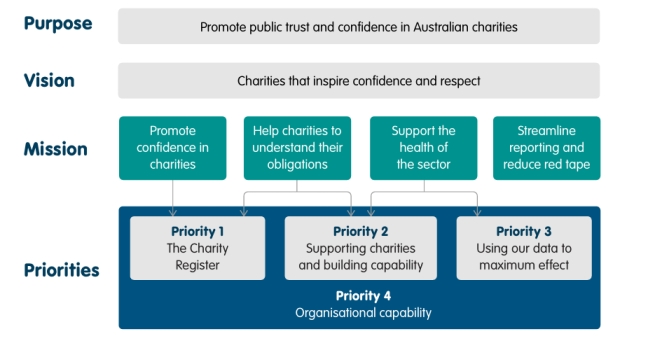
Vision: Charities that inspire confidence and respect.
Mission: Promote confidence in charities; help charities to understand their obligations; support the health of the sector; streamline reporting and red tape.
Priorities: Priority 1 – The Charity Register; Priority 2 – Supporting charities and building capability; Priority 3 – Using our data to maximum effect; Priority 4 – Organisational capability.
Sue Woodward AM was appointed to the role of Commissioner on 12 December 2022.
The ACNC has six directorates. See Figure 2.
Figure 2 – ACNC structure
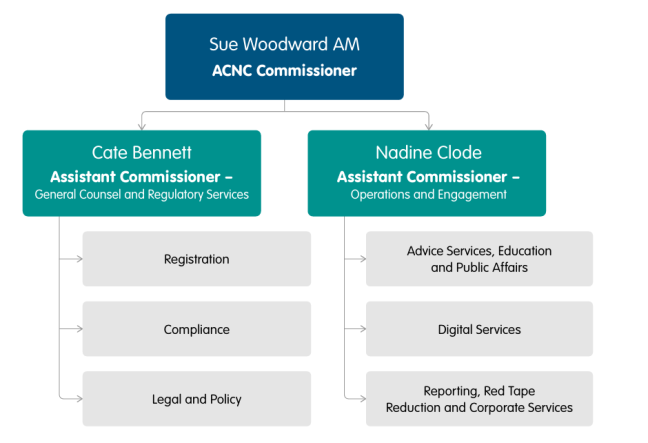
Cate Bennett – Assistant Commissioner – General Counsel and Regulatory Services: Registration; Compliance; Legal and Policy.
Nadine Clode – Assistant Commissioner – Operations and Engagement: Advice Services, Education and Public Affairs; Digital Services; Reporting, Red Tape Reduction and Corporate Services.
The ACNC was supported during 2025–26 by temporary specialist resources, including a Strategic Adviser (Michael O’Neill) and three Project Directors provided by the Commissioner of Taxation.
We regulate charities in accordance with:
- our Regulatory Approach Statement
- the Statement of Expectations issued by the Assistant Minister for Productivity, Competition, Charities and Treasury and our corresponding Statement of Intent
- the Australian Government’s Regulatory Policy, Practice and Performance Framework.
Our regulatory activities cover a charity’s entire lifecycle. Most of our efforts are focused on education and support, although we will use other powers based on the seriousness of the offence, or the risk to public trust and confidence.
This ensures that we:
- effectively target key issues that have the greatest impact on public trust and confidence
- maximise charities’ voluntary compliance with our obligations.
Priority 1 – The Charity Register
1.1 Percentage of time that the Charity Register is available (excluding scheduled maintenance)*
1.2 Percentage of new eligible charities registered within 15 business days of ACNC receiving all information necessary to make a decision*
1.3 Percentage of Annual Information Statements (AIS) submitted by the due date
1.4 Percentage of investigations finalised within 90 business days of ACNC receiving all information necessary to make a decision
1.5 When a charity is notified of an investigation, the percentage of investigations that result in a regulatory action
1.6 Percentage of DGR-endorsed charities reviewed to confirm eligibility of subtype and registration
1.7 Processing/making a decision on the following forms within seven business days of receiving all the information: 3A, 3B, 4A, 4B, 4C, 4D, Paper AIS
1.8 Making a decision within 15 business days of receiving all information for the following forms: 1C, 1D, 5A
*These two key performance indicators are listed as the ACNC’s performance measures in the Portfolio Budget Statements (PBS) for the Australian Taxation Office listed entity under the Public Governance, Performance and Accountability Act 2013 (Cth). Our performance against the two PBS measures is also published in the Commissioner of Taxation’s annual report.
Priority 2 – Supporting charities and building capability
2.1 Percentage of calls answered within four minutes and percentage of written correspondence responded to within seven business days of receiving all information necessary to respond
2.2 Percentage of users that find our guidance useful
2.3 Percentage of charity recipients that open The Charitable Purpose newsletter
2.4 Percentage of respondents satisfied with the service provided during the registration application process
2.5 Percentage of respondents that find questions in the Annual Information Statement easy to understand
Priority 3 – Using our data to maximum effect
3.1 Percentage of datasets delivered to other regulators (as part of data sharing arrangements) on-time
3.2 Views of the ACNC data hub
3.3 Percentage of datasets on data.gov.au updated weekly
Priority 4 – Organisational capability
4.1 Acknowledging a complaint about the ACNC within three business days and responding within 20 business days
4.2 Responding to Privacy Act requests within 30 calendar days
ACNC regulatory activities against our KPIs
Information |
| Activities: Intelligence and compliance-driven content and updates KPIs: 2.2, 2.3, 3.2, 3.3 |
Registration |
| Activities: Post registration email KPIs: 1.2, 2.4 |
Education |
| Activities: Regulatory focus areas, initiatives to support sector (DRD summaries), information sharing, compliance reviews KPIs: 2.2 |
Enquiries or advice |
| Activities: DGR review, general or regulatory advice (verbal/written) KPIs: 1.6, 2.1 |
Reporting |
| Activities: AIS reminder campaigns, financial reporting reviews, data sharing with regulators KPIs: 1.3, 2.5, 3.1 |
Late or failure to report |
| Activities: Late filer emails, investigations/referrals, penalties KPIs: 1.4, 1.5 |
Register review |
| Activities: Referrals KPIs: 1.1 |
Portal updates |
| Activities: Subtype reviews, reporting period changes, group reporting review, withholding work, other reviews/requests KPIs: 1.7, 1.8 |
Monitoring |
| Activities: Proactive compliance work, information notices, determinations, compliance agreements, data analytics and intelligence KPIs: 1.4, 1.5 |
Concerns |
| Activities: Privacy Act requests, self-audits/investigations, suspension/removal of Responsible Person, enforceable undertakings, warnings, directions, injunctions, regulatory advice KPIs: 1.4, 1.5, 4.1, 4.2 |
End | Activities: Voluntary revocation, double defaulter process, revocation, cancelled ABN review, ORIC deregistered entities review KPIs: 1.4, 1.5, 1.8 |
General ACNC engagement
- Charity Forum
- Governing for Good forum
- Speaking events
- Stakeholder liaison
- Presentations
Government
- Law reform
- Policy
- Submissions
Our work in 2025-26
Table 1 – Performance against key performance indicators
| Key performance indicator | Target | Result |
| 1.1 Percentage of time that the Charity Register is available (excluding scheduled maintenance) | 99% | 99.68% Met |
| 1.2 Percentage of new eligible charities registered within 15 business days of ACNC receiving all information necessary to make a decision | 90% | 94% Met |
| 1.3 Percentage of 2025 Annual Information Statements submitted by the due date | 75% | 76% Met |
| 1.4 Percentage of investigations finalised within 90 business days of ACNC receiving all information necessary to make a decision (applies where a charity is notified of an investigation | 75% | 90% Met |
| 1.5 When a charity is notified of an investigation, the percentage of investigations that result in a regulatory action | 90% | 99% Met |
| 1.6 Percentage of DGR-endorsed charities reviewed to confirm eligibility of subtype and registration | 545 (2%) | 514 Partially met |
1.7 Processing/making a decision on the following forms within seven business days of receiving all the information:
| 80% | 91% Met |
1.8 Making a decision within 15 business days of receiving all information for the following forms:
| 90% | 87% Partially met |
| 2.1 Percentage of calls answered within four minutes, and percentage of written correspondence responded to within seven business days of receiving all information necessary to respond | 80% | 88% Met |
| 2.2 Percentage of users that find our guidance useful | 80% | 83% Met |
| 2.3 Percentage of charity recipients that open The Charitable Purpose newsletter | 44% | 56% Met |
| 2.4 Percentage of respondents satisfied with the service provided during the registration application process | 90% | 95% Met |
| 2.5 Percentage of respondents that find questions in the Annual Information Statement easy to understand | 90% | 94% Met |
| 3.1 Percentage of datasets delivered to other regulators (as part of data sharing arrangements) on-time | 97% | 98% Met |
| 3.2 Views of the ACNC data hub | 6,200 | 6,534 Met |
| 3.3 Percentage of datasets on data.gov.au updated weekly | 90% | 90% Met |
| 4.1 Acknowledging a complaint about the ACNC within three business days and responding within 20 business days | 95% | 100% Met |
| 4.2 Responding to Privacy Act requests within 30 calendar days | 100% | 100% Met |
Criterion result grading
| Result | Description |
| Met | Target met or exceeded |
| Partially met | 80% or more of the target was achieved |
| Not met | Less than 80% of the target was achieved |
Below are our four strategic priorities. The following section provides more detail about our work and achievements under each priority, and reports our performance against the relevant key performance indicators.
Figure 4 - How this section is structured
| Strategic priorities | Our work | Relevant key performance indicators (KPIs) |
|---|---|---|
| Priority 1 The Charity Register |
| 1.1–1.8 |
| Priority 2 Supporting charities and building capability |
| 2.1–2.5 4.1–4.2 |
| Priority 3 Using our data to maximum effect |
| 3.1–3.3 |
| Priority 4 Organisational capability |
|
We then discuss our regulatory focus area for 2025–26, effective record-keeping, which complements our ongoing compliance and enforcement priorities.
The final two sections outline how we engage with our key stakeholders and how we work to be a ‘best practice’ regulator.
The Charity Register is the ACNC’s key means of promoting public trust and confidence in Australia's charities. Anyone can search the Register to find out more about a specific registered charity. Those who often use the Register include:
- volunteers, the public and donors, who can use it to find charities to support
- charities, who can use it to identify like-minded charities to collaborate with
- state, territory and Commonwealth government agencies, funders and grant-makers, who can use it to easily access charity information, reducing the need to contact charities to ask for the same information
- the media, researchers and the public, who can use it to better understand the sector.
In 2025–26, the Register was searched more than 2.1 million times
KPI 1.1 – Percentage of time that the Charity Register is available (excluding scheduled maintenance) (Target: 99%, Result: 99.68%)
The importance of the Charity Register underpins our commitment to ensuring it is available 24/7 (excluding scheduled maintenance). During the year, the Register was available for 99.68% of the time. Our monitoring tool indicated that the Register was not available for a total of 1,657 minutes (just over 27 hours).
To appear on the Register, an organisation must be registered as a charity with the ACNC. If an organisation has its charity registration revoked (for example, due to an investigation, or because it has wound up), the revoked status will be shown on the Register.
Figure 5 shows the three key elements of the ACNC's regulatory processes.
Figure 5 – The ACNC's regulatory process, and our role in ensuring an accurate Charity Register
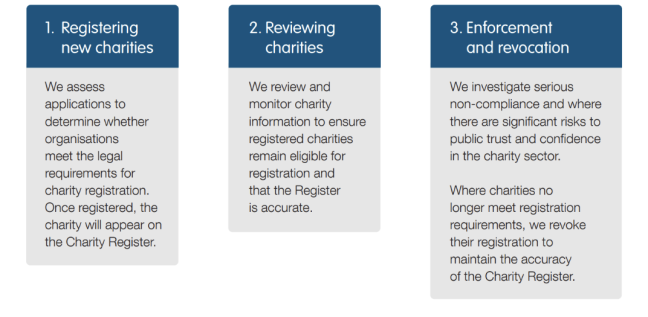
2. Reviewing charities: We review and monitor charity information to ensure registered charities remain eligible for registration and that the Register is accurate.
3. Enforcement and revocation: We investigate serious non-compliance and where there are significant risks to public trust and confidence in the charity sector. Where charities no longer meet registration requirements, we revoke their registration to maintain the accuracy of the Charity Register. The following section further explains how the ACNC’s registration, review and compliance activities support the accuracy of the Charity Register.
The following section further explains how the ACNC's registration, review and compliance activities support the accuracy of the Charity Register.
1. Registering new charities
To be registered by the ACNC, an organisation must meet the legal meaning of ‘charity’. It is important for the ACNC to process new applications from eligible organisations quickly to support charities wishing to access available taxation benefits and concessions.
KPI 1.2 – Percentage of new eligible charities registered within 15 business days of ACNC receiving all information necessary to make a decision (Target: 90%, Result: 94%)
To be registered by the ACNC, an organisation must meet the legal meaning of ‘charity’.
In 2025–26, the ACNC registered 3,696 new charities. 94% were registered within 15 business days of receiving all information necessary to make a decision.
With the self-assessing income tax exemption (SAITE) reforms entering their third year of implementation (the reforms started from 1 July 2023), the impact on application numbers remained significant, although less pronounced than in previous years. In 2025–26, at least 42% of applicants reported they applied due to these reforms, compared to 51% in 2024–25.
The ACNC offers a streamlined bulk application process for organisations with similar charitable purposes, enabling them to be registered more efficiently. The ACNC registered 54 charities via the bulk application process in 2025–26, compared with 503 in the previous year. Because of this, a greater proportion of applications progressed through the standard registration process.
Table 2 – Applications received
| Financial year | Number of applications received |
|---|---|
2025–26 | 5,871 |
2024–25 | 6,285 |
2023–24 | 6,286 |
2022–23 | 5,535 |
2021–22 | 5,621 |
2020–21 | 5,886 |
2019–20 | 5,746 |
Note: The ACNC introduced a new registration form in June 2024, which has reduced the proportion of resubmitted applications. For this reason, some caution should be considered when comparing application volumes over time. Resubmissions represented 20% of applications in 2025–26, compared with 28% in 2023–24 (the year the new registration form was launched).
2. Reviewing charities
Once registered with the ACNC, charities must meet ongoing obligations by:
- maintaining their entitlement to registration
- notifying the ACNC of certain changes
- keeping financial and operational records
- reporting annually via the Annual Information Statement
- complying with the ACNC Governance Standards (unless exempt) and External Conduct Standards (if operating or sending money overseas).
Some charities are exempt from submitting an Annual Information Statement. For example, Aboriginal and Torres Strait Islander corporations registered with the Office of the Registrar of Indigenous Corporations (ORIC) can report directly to ORIC. ORIC maintains a public register which identifies whether an ORIC entity is registered with the ACNC.
The ACNC dedicates significant resources in supporting charities to comply with their obligations to the ACNC, helping to ensure the Charity Register remains accurate.
For example, the ACNC uses multiple channels to remind charities of the need to submit annual reporting (the Annual Information Statement) – these include emails, phone calls, letters and social media.
The Annual Information Statement asks for information about a charity’s programs, beneficiaries, human resources (paid staff and volunteers) and finances. Unless exempt, medium and large charities must provide reviewed or audited annual financial reports with their Annual Information Statement.
KPI 1.3 – Percentage of 2025 Annual Information Statements submitted by the due date (Target: 75%, Result: 76%)
At 30 June 2026, 76% of charities had submitted their Annual Information Statement by the due date, a significant improvement compared to 73% in the previous year.
In 2025–26, we added new initiatives to better support charities to comply with their Annual Information Statement obligations. We used our data to identify specific cohorts of charities that were often late in reporting, and provided tailored support, including by engaging with peak bodies.
For example, our data has shown that newly registered charities are often late in reporting to the ACNC. Based on the learnings from our work with the Australian Centre for Evaluation which trialled the impact of sending an additional reminder to a Responsible Person – our email reminders to newly registered charities now include both the Responsible Person and the Address For Service, which is the primary address the ACNC uses for correspondence.
We also held webinars and published other guidance (see Priority 2 for further information).
Our results show that initiatives such as these are delivering results, noting that the number of charities submitting their Annual Information Statement on-time is also increasing even as the total number of registered charities grows.
Apart from the Annual Information Statement and registration application, we also processed or made a decision on more than 5,300 forms, again helping to ensure the Charity Register was up to date.
KPI 1.7 – Processing/making a decision on the following forms within seven business days of receiving all the information (Target: 80%, Result: 91%)
- Form 3A – Change of Responsible Person
- Form 3B – Change of charity details
- Form 4A – Request substituted accounting period
- Form 4B – Request group reporting
- Form 4C – Bulk Annual Information Statement
- Form 4D – Apply to keep charity size
- Paper Annual Information Statement
We processed 3,430 forms this year, up from the 2,950 forms we processed the previous year. Around 91% (3,107) were processed within seven business days of the ACNC receiving all required information.
Forms 3A and 3B were the most common forms processed.
KPI 1.8 – Processing/making a decision on the following forms within fifteen business days of receiving all the information (Target: 90%, Result: 87%)
- Form 1C – Change charity subtype
- Form 1D – Request withholding
- Form 5A – Apply to revoke registration
Charities can ask the ACNC to approve or remove charity subtypes, request the ACNC withhold information from the Charity Register or request that the ACNC revoke charity registration.
This year, we made a decision on 1,877 forms. Of those forms, 87% (1,632) of decisions were made within 15 business days of receiving all information, compared to 89% the previous year.
Of the three forms included in this KPI, the most common form we received was Form 5A. For analysis of voluntary revocations, refer to Priority 1 – Revocation of charity status.
We continue to identify and implement initiatives aimed at streamlining processes and improving our performance against this KPI.
In addition to responding to requests from charities (such as for us to process forms, or to make decisions on other requests), we analyse and review information to ensure charities are complying with their obligations and remain eligible to be registered. This includes:
- reviews into DGR-endorsed charities to confirm eligibility of subtype and charity registration
- financial reporting reviews, which assess compliance with ACNC reporting requirements
- compliance reviews, which focus on charities at greater risk of failing to meet obligations under the ACNC Governance Standards or ACNC External Conduct Standards.
Reviews into DGR-endorsed charities to confirm eligibility of subtype and charity registration
These reviews can include two stages:
- Stage 1: an initial desktop assessment, which includes ensuring that the Charity Register contains accurate information. If that initial review uncovers any issue about the charity’s subtype or its entitlement to registration – or if we need further information to help us make an assessment – we conduct a more detailed review.
- Stage 2: as part of a more detailed review, we will contact the charity to discuss any issues.
In 2025–26, we completed 514 reviews focused on charities at higher risk of non-compliance, such as misuse of charitable assets, harm to people, or having a disqualifying purpose.
KPI 1.6 – Percentage of DGR-endorsed charities reviewed to confirm eligibility of subtype and charity registration (Target: 545 [2% of registered charities], Result: 514)
We completed 514 DGR reviews (94% of our target).
A higher number of charities selected for review voluntarily requested their registration be revoked before a DGR review could begin, affecting our results. In addition, reviews started later than in previous years, limiting our ability to add replacement charities to ensure we met our target of DGR reviews. In the future we will more closely monitor the status of charities selected for review, enabling us to identify and more quickly replace charities whose registrations have been revoked.
Table 3 – Outcomes for DGR-endorsed charities selected for a 2025–26 review
| Outcome | Number |
|---|---|
| No detailed review required, but support provided to help the charity update its details on the Charity Register | 69 |
| Escalated for a detailed review | 84 |
| No further action required – charity entitled to subtype and charity registration | 361 |
Financial reporting reviews
Each year, we conduct targeted financial reporting reviews to assess medium and large charities’ compliance with ACNC reporting requirements. This process includes a review of information in the Annual Information Statement, as well as the annual financial report.
Where relevant – including where information is missing – we contact the charity and support them in updating the Charity Register.
These reviews help us identify where charities might be experiencing challenges complying with reporting requirements and help shape the quality and content of our guidance. Findings are published on our website and shared throughout the sector.
In 2025–26, we completed 250 reviews. We contacted 93 charities that made a material error.
As of 30 June, our reviews led to errors involving $4 billion in total revenue and $3.7 billion in total assets being corrected on the Charity Register.
We expect to publish our findings from these financial reporting reviews in October 2026.
Compliance reviews
We use voluntary compliance reviews to better understand whether risks exist in certain parts of the sector, to understand examples of good practice and to better see where improvements can be made to help us share findings through news articles, The Charitable Purpose and through updates to our guidance.
In 2025–26, we conducted reviews to ask how charities identify and manage the risk of being misused to support terrorism financing.
We conducted 37 voluntary reviews, which involved meeting with the charities and requesting information so we could better understand how they managed the risk of terrorism, and how they worked with overseas partners in compliance with the ACNC External Conduct Standards.
We have published a summary of the findings on our website.
3. Enforcement and revocation
Concerns
In 2025–26, we received concerns about 1,863 charities, an increase of 223 from the previous year.
All concerns are assessed using the ACNC’s risk-based regulatory approach.
Eighty-eight percent of the concerns we received came from members of the public. We continued to see an increase in coordinated campaigns, with groups responsible for these campaigns often using the same template and, in some cases, possibly using artificial intelligence to generate submissions.
The top three concern categories, as self-selected by those submitting the concern, related to:
- disqualifying purpose (political, unlawful or contrary to public policy)
- private benefit
- mismanagement.
Self-audits
The ACNC conducts self-audits, where we use our legislative powers to require a charity to respond to questions related to their compliance with Governance Standards and, where applicable, External Conduct Standards.
Depending on the response, we may take no further action, provide tailored regulatory advice that supports charities to comply with their obligations to the ACNC, or launch a formal investigation if serious issues are identified.
This year, we issued 248 self-audits.
Nearly all self-audits – 245 out of the 248 – were issued to charities identified as being at a higher risk of misuse for terrorism financing. The self-audits asked these charities to address how they managed several elements of their overseas operations, including:
- identification and management of risks for their operating locations
- appropriate due diligence when working with overseas partners
- financial management, where funds or resources are used overseas
- record-keeping for overseas operations.
As part of our education-first approach, we provided charities that completed self-audits with guidance on topics including risk management, working with partners and financial management.
Fourteen charities were subject to further ACNC review because they either did not complete their self-audit, or their response raised matters requiring closer examination.
Investigations
Investigations represent the ACNC’s most significant response to suspected non-compliance.
In line with our regulatory approach, we begin an investigation when we identify a risk of serious and/or deliberate non‑compliance.
In 2025–26, we finalised 71 investigations after notifying charities we would investigate their compliance with the ACNC Act.
How the ACNC conducts investigations
Complex investigations can span multiple years, and during an investigation the ACNC may take one or more regulatory actions.
For example, the ACNC may issue an enforceable undertaking during an active investigation into a charity. The undertaking could require the charity to improve any governance failings within 12 months. The ACNC would then keep the investigation open during that 12-month period to monitor the charity’s compliance with the undertaking.
The ACNC closes an investigation only when the charity has resolved relevant matters, when we revoke the charity’s registration or when we find no further action is required.
Regulatory actions at the ACNC include:
- education such as advice on improving record-keeping or financial management policies
- compliance agreements – for example, an action plan to improve management practices
- legislative enforcement powers such as enforceable undertakings and warnings
- additional reporting obligations – for example, requiring charities to report on how they have resolved certain issues
- revocation of charity status, which is the most serious step that the ACNC can take as it removes a charity’s eligibility for tax concessions, as well as other government benefits.
While revocation is the most serious regulatory action available to the ACNC, it is not always the most proportionate regulatory response.
Before revoking a charity’s registration, the Commissioner must consider a range of additional factors outlined in the ACNC Act. These include harm to public trust and confidence, and the welfare of charity beneficiaries. In some cases, the ACNC can also choose to defer revocation on the request of another government agency that may also be investigating the same charity.
This is an important consideration when the ACNC looks to revoke a charity’s registration, as once a charity's registration is revoked, the ACNC no longer has regulatory oversight of that organisation.
KPI 1.4 – Percentage of investigations finalised within 90 business days of the ACNC receiving all information necessary to make a decision (this applies where a charity is notified of an investigation) (Target: 75%, Result: 90%)
The ACNC is committed to finalising investigations in a timely manner, and this KPI focuses on investigations finalised during 2025–26.
The timeliness of an investigation is affected by multiple factors, such as the complexity of the matter being investigated, whether we are working with other regulators about the concerns being investigated, and how cooperative the charity is in providing the information we need.
When we contact a charity in relation to an investigation, we define ‘receiving all information’ as the point where we receive a response from the charity that:
- provides sufficient evidence to demonstrate its compliance, or
- shows it has undertaken governance reforms in consultation with – or as required by – the ACNC, or
- responds to the matters we have asked it to address – for example, matters outlined in a show cause notice.
Of the 71 investigations we finalised during 2025–26, 64 (90%) were finalised within 90 business days of the ACNC receiving all information necessary to make a decision.
KPI 1.5 – When a charity is notified of an investigation, the percentage of investigations that result in a regulatory action (Target: 90%, Result: 99%)
An investigation represents the ACNC’s most significant response to a charity’s suspected non-compliance. We aim to begin an investigation only where we suspect serious non-compliance.
Unlike KPI 1.4 (which focuses on investigations finalised in 2025–26), this KPI focuses on regulatory actions issued – including both open and finalised investigations (for further information, see ‘How the ACNC conducts investigations’).
In 2025–26, we took 75 regulatory actions relating to 73 open or closed investigations. We closed one investigation without any regulatory action.
Regulatory actions included:
- 27 revocations of charity registration
- one voluntary revocation, which we accepted as the organisation had wound up and ceased operating
- one warning
- one enforceable undertaking
- 33 occasions where we provided regulatory advice
- one action where we required the charity to provide additional reporting to the ACNC on how it had resolved a particular matter
- 10 compliance agreements
- one suspension of a charity’s Responsible Person, and two acting Responsible People being appointed to a charity.
The ACNC often had multiple reasons for revoking a charity’s registration. The most common reasons related to:
- non-compliance with Governance Standards or External Conduct Standards (particularly in relation to Governance Standard 5: Duties of Responsible People)
- failure to provide the ACNC with additional reporting as required.
Revocation of charity status
The ACNC revokes the charity status of organisations that are no longer entitled to be on the Charity Register.
Once its charity registration is revoked, an organisation will lose its access to any tax concessions and other government benefits.
For example, the ACNC has established streamlined obligations with other bodies to reduce duplication and fees. If an organisation loses its charity status, it may need to lodge a separate annual return to relevant regulators and pay an annual fee.
There are generally two types of revocations:
- Revocation due to ACNC action: this includes revocation of charity registration following an investigation, due to the organisation having a cancelled ABN (which is a requirement for charity registration under the ACNC Act) or due to persistent non-reporting. The ACNC refers to this as being a ‘double defaulter’. We classify a double defaulter as any charity that has not submitted two or more Annual Information Statements.
- We make numerous attempts to contact double defaulter charities (which includes publishing a list of these charities on our website) and request they submit any outstanding Annual Information Statements within 28 days of the most recent correspondence being sent. If they fail to do so, we revoke their charity registration.
- Voluntary revocation: a charity can request voluntary revocation of its registration for a range of reasons – for example, if it is no longer operating.
This year, we revoked the charity registrations of 1,298 organisations:
- we revoked the registrations of 122 organisations due to ACNC action – including 27 following an investigation
- there were 1,176 organisations that requested their charity registration be voluntarily revoked.
Table 4 – Reason for voluntary revocation
| Reason for voluntary revocation | % of total 2024–25 | % of total 2025–26 |
|---|---|---|
| No longer wants to be a registered charity | 3 | 2 |
| Merged with another charity | 12 | 12 |
| Merged with another charity | 84 | 86 |
| Not entitled to be a charity | <1 | <1 |
| TOTAL | 100 | 100 |
We are committed to supporting charities to improve their governance, including through better understanding and meeting their obligations to the ACNC. Key activities we undertake to achieve this include:
- promptly responding to calls and enquiries
- publishing useful guidance and resources
- providing quality customer service and treating the public with courtesy and respect
- making our forms as easy to use as possible.
Responding to calls and enquiries
In 2025–26, we answered 20,297 calls and responded to 12,042 written enquiries, a total of 32,339 enquiries.
The average call wait time was one minute and 55 seconds.
Like the previous year, our most common enquiry related to accessing and navigating the Charity Portal. While some people will always require one-on-one support, we continue to promote our guidance and videos to make it easier for those who need support accessing the Charity Portal.
KPI 2.1 – Percentage of calls answered within four minutes, and percentage of written correspondence responded to within seven business days of receiving all information necessary to respond (Target: 80%, Result: 88%)
Of the 32,339 enquiries, we responded to 88% (28,522) within the relevant timeframe – within four minutes for calls and seven days of receiving all information necessary for written enquiries.
While we exceeded our target, our performance was lower than in the previous year (92%), primarily due to resourcing.
Publishing guidance and resources
The ACNC recognises there is great diversity across the charity sector – and that most charities are small, with about half operating without paid staff. To cater for this, the ACNC provides different types of guidance and resources, including web guidance, online self-assessment tools, webinars and videos.
In 2025–26, new pieces of guidance published on our website included:
- guidance on investing charity money
- governing practices for charities operating in complex structures
- the 2025 Annual Information Statement Guide.
KPI 2.2 – Percentage of users that find our guidance useful (Target: 80%, Result: 83%)
Users can provide feedback on the usefulness of 238 pieces of guidance on our website.
This year, 4,045 users provided feedback on these pages. Some 83% (3,351) rated our guidance as useful, matching the previous year’s result.
The top-rated webpage by the number of users that provided feedback was the registration application and guide, which was rated as useful by over 93% of users.
To increase accessibility, we began using artificial intelligence to produce audio transcripts of our news articles.
We also made significant updates to two key resources that help support charities, the public and their advisers.
- following public consultation, the ACNC comprehensively revised its suite of template constitutions for charities structured as companies limited by guarantee (CLG). This was done to ensure the templates remain useful and reflect relevant changes in law. These template constitutions provide foundational support for charities, and have been downloaded 11,499 times since being published on 31 July 2025. There are five versions of the template, tailored to specific types of charities.
- The ACNC also updated its Commissioner’s Interpretation Statement (CIS) on Public Benevolent Institutions (PBIs) following extensive consultation with the charity sector, and legal and professional advisers. In line with the 2024 judgement of the Full Court of the Federal Court on Equality Australia’s PBI status, the updated CIS makes clear that the ordinary meaning of PBI will continue to evolve over time. The CIS also makes clear that the Commissioner takes a contemporary approach to the issue, and will consider the contemporary ways organisations look to relieve benevolent needs. Since being updated on 29 September 2025, there have been 7,903 views of the page.
We continued building our library of de-identified registration decision summaries (DRDs), which provides potential applicants with an insight into the ACNC’s decision-making processes around how we apply the law when registering charities. In 2025–26, we published 11 DRDs on topics such as how the ACNC assesses if activities align with an organisation’s charitable purpose, private benefit and protecting vulnerable people overseas.
To help promote good governance, we also published five new online charity governance tools, covering:
- conflicts of interest
- related party transactions
- record-keeping
- financial management, and
- safeguarding.
Additionally, we held two webinars to help charities to understand and meet their ACNC obligations:
- Everything you need to know about the Annual Information Statement. This webinar was aimed at helping charities reporting to the ACNC for the first time and had 414 attendees. Some 63% of attendees rated the webinar as ‘extremely useful’, while 37% rated it as ‘useful’. The recording of the webinar has been viewed 3,500 times on YouTube.
- What you need to know about being a registered charity. This webinar focused on helping charities meet their ongoing obligations and had 443 attendees. At the beginning of the session, we asked attendees to rate how confident they were in meeting their charity obligations – with 39% of attendees rating their confidence in meeting their ongoing obligations as ‘neutral or not confident’. By the end of the webinar, 89% said they felt ‘somewhat confident’ or ‘extremely confident’ in meeting their obligations. The recording of the webinar has been viewed nearly 1,000 times on YouTube since May 2026.
The ACNC uses The Charitable Purpose – our monthly newsletter – to highlight our guidance and resources, and to provide timely information to the sector. It also includes a Commissioner’s Column and other news relevant to the sector.
The newsletter is sent to all charities via what we call their Address For Service – the email address charities provide to the ACNC. In addition, anyone can subscribe.
Subscriber numbers increased significantly in 2025–26 to nearly 16,000 subscribers compared to 13,989 at the end of the previous financial year. As of 30 June, around 65,000 recipients (subscribers and charities) received The Charitable Purpose.
KPI 2.3 – Percentage of charity recipients that open The Charitable Purpose newsletter (Target: 44%, Result: 56%)
We use the open rate as a gauge of sector engagement with ACNC content and guidance.
Across the year, 56% of our emails were opened, exceeding our performance from last year (54%) and our target of 44% (which was based on our 2022-23 open rate). Data published by Mailchimp in 2024 showed the average open rate for ‘government’ emails was 41%.
The highest open rate was 70% for the November edition, which featured a series of articles on the outcomes of ACNC reviews of financial reports, and about charities operating within complex structures.
We use social media to promote ACNC news and education resources, and to engage with stakeholders and a broader audience. We also amplify relevant posts from stakeholder organisations to bring important updates to our followers.
Over the last financial year, the ACNC has continued to evolve its social media presence by refreshing its branding to create a more modern, consistent and recognisable look across Facebook, LinkedIn and Instagram.
This has helped drive a gain in followers on these platforms – for example, our LinkedIn follower numbers grew by about 22% from around 6,700 followers to 8,000 this year.
Providing quality services and making our forms as easy to use as possible
The ACNC is committed to providing high quality services at all times.
This includes treating everyone with respect and courtesy, ensuring our information is easy to understand, and constantly monitoring and improving our services.
KPI 2.4 – Percentage of respondents satisfied with the service provided during the registration application process (Target: 90%, Result: 95%)
Whenever we decide on a registration application, we send a survey that allows applicants to provide anonymous feedback.
In 2025–26, we received 384 responses. Some 95% (366) of respondents were either ‘very satisfied’ or ‘satisfied’ with the service provided, which was slightly above the previous year’s result (94%).
Figure 6 – Satisfaction of service during registration application
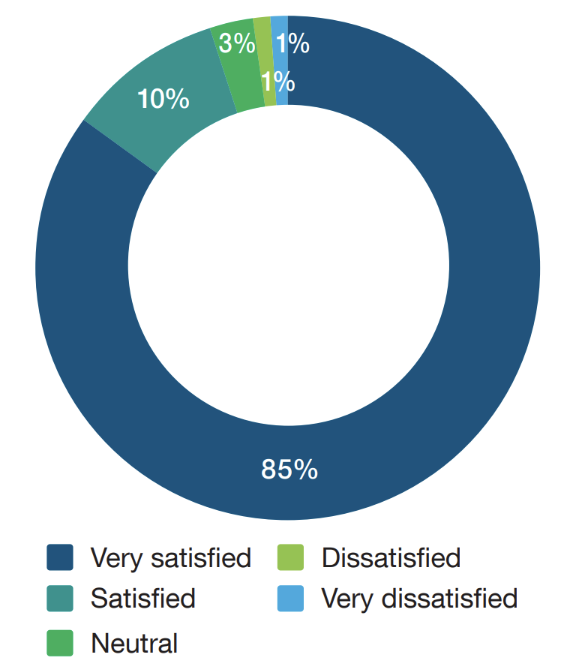
Very satisfied - 85%
Satisfied - 10%
Neutral - 3%
Dissatisfied - 1%
Very dissatisfied - 1%
KPI 2.5 – Percentage of respondents that find questions in the Annual Information Statement easy to understand (Target: 90%, Result: 94%)
After submitting their 2025 Annual Information Statement, users were asked to complete an anonymous survey about their experience submitting the statement.
In total, 1,637 responses were received. Of those, 94% (1,535) found the questions easy to understand. This was a slight increase on the previous year (93%) and exceeded our target of 90%.
Users generally found the finance section of the Annual Information Statement the most difficult to complete. We have used this feedback to help improve the next Annual Information Statement and related guidance.
KPI 4.1 – Acknowledging a complaint about the ACNC within three business days, and responding within 20 business days (Target: 95%, Result: 100%)
The ACNC is committed to continuous improvement, and we adopt the Commonwealth Ombudsman’s Better Practice Complaint Handling Guide when handling complaints.
The guide defines a complaint as ‘An implied or express statement of dissatisfaction where a response is sought, reasonable to expect or legally required.’
In 2025–26, we received 25 complaints, all of which we responded to within 20 business days. Complaints were generally associated with the ACNC’s forms and processes, and they provided insights that informed ongoing continuous improvement activities.
KPI 4.2 Responding to Privacy Act requests within 30 calendar days (Target: 100%, Result: 100%)
The Office of the Australian Information Commissioner requires government agencies to respond to Privacy Act requests to access personal information within 30 calendar days.
In 2025–26, we received one request, and this was actioned within the required timeframe.
To help charities, their advisers and the public better understand our work, the ACNC publishes annual regulatory focus areas. These highlight the areas that will receive increased regulatory attention during the year.
These focus areas touch on the entire lifecycle of registered charities, and are complementary to the ACNC’s ongoing compliance and enforcement priorities outlined below. Our regulatory focus also includes education and our work towards the integrity of the ACNC Charity Register.
Our focus areas draw on:
- issues we have identified that, where addressed, will support charities to protect themselves from risk, and
- emerging trends or common failures that we see through our work with the sector.
For 2025–26, we focused on effective record-keeping.
Charity record-keeping
Through the ACNC’s work, we have found that charities lacking appropriate record keeping commonly experienced other governance failures.
These include:
- poor management of conflicts of interest, leading to decisions that did not serve the charity’s best interests
- fraud and financial misconduct, including charity funds being primarily used for the private benefit of Responsible People (or those related to them) rather than for achieving charitable purposes
- the inability to appropriately safeguard vulnerable people, and
- broader issues with inadequate management practices, which could lead to a range of other governance failures.
To support charities in better complying with their record-keeping obligations, we promoted our record-keeping guidance on our website and social media, as well as in speaking engagements and news articles.
We also launched a new online record-keeping tool which allows charities to self-assess their compliance against record-keeping obligations, and to identify any areas of improvement. Since its launch on 17 December 2025, the tool has had over 2,700 views.
Sub-sector focus: charities operating overseas
We also conducted significant work to better understand and support charities that work overseas. This included:
- 37 compliance reviews
- 245 self-audits
- 65 financial reporting reviews
- a survey for charities working internationally about their experiences and challenges with banking services, including debanking
- a forum specifically focused on charities operating overseas, which included representatives from the Australian Federal Police, Department of Home Affairs, AUSTRAC, Australian Council for International Development, Department of Foreign Affairs and Trade, Governance Institute of Australia, and Queensland University of Technology. Notes from the forum have been published on our website.
We released the key findings from the compliance reviews in April 2026, noting that we found most charities operating overseas were able to identify and manage risks associated with their operating environments and activities, handle and manage money safely and protect staff and beneficiaries. However, some did not have adequate practices and safeguards in place.
We promoted the findings through our newsletter, The Charitable Purpose, and across our social media channels.
We hold a large amount of data about Australia’s charities. We are committed to sharing our data and insights as widely as possible to help inform stakeholders about the charity sector. This enables stakeholders to use our data to help inform their work. For example, a charity peak body can use ACNC data to highlight the impact of specific charity cohorts in an individual state or territory.
Sharing charity data across government
As part of our ‘report once, use often’ framework, we securely share our data with government agencies, reducing unnecessary regulatory burden on charities by removing the need for other regulators to ask for the same information.
In general, the ACNC shares data securely with government via two methods:
- formal data sharing arrangement (for example, as outlined in a Memorandum of Understanding)
- the ACNC Charity Passport.
KPI 3.1 – Percentage of datasets delivered to other regulators (as part of data sharing arrangements) on-time (Target: 97%, Result: 98%)
As part of our efforts to reduce regulatory burden across the charity sector, we have several data sharing arrangements with other regulators. This performance indicator captures the data we share through a secure automated IT process. This does not include ad-hoc or manual datasets which we also support as needed.
This year, we ran 3,409 IT ‘reports’, which can include multiple datasets. Almost all (98%) were provided on-time in accordance with our agreement with the other regulator.
This is a slight improvement on the previous year, where 96% of datasets were provided on-time.
Using data and insights to support government decision-making
We made six submissions during the year – available on our website – using our data and insights to illustrate the impact of government reform on the charity sector. We provided submissions to the:
- Senate Economics Legislation Committee (April 2026) – Inquiry into the Treasury Laws Amendment (Delivering an Efficient and Trusted Tax System) Bill 2026
- Parliamentary Joint Committee on Corporations and Financial Services (February 2026) – Inquiry into the provision, regulation and pricing of modern insurance products for small businesses
- Standing Committee on Communications, the Arts and Sport (February 2026) – Inquiry into Arts, and Cultural Philanthropy
- Senate Standing Committee on Economics (November 2025) – Inquiry into Treasury Laws Amendment (Strengthening Financial Systems and Other Measures) Bill 2025
- Parliamentary Joint Committee on Law Enforcement (September 2025) – Capability of law enforcement to respond to cybercrime
- Victorian Parliament’s Legislative Assembly Legal and Social Issues Committee (August 2025) – Recruitment methods and impacts of cults and organised fringe groups.
Publishing and analysing charity sector data
We also share our data with the public, media and researchers so they can better understand the diversity of Australia’s charity sector.
Our Charity Data Hub centralises the data we hold and publish. The hub includes links to all editions of the Australian Charities Report, which summarise data charities submit through their annual reporting. It also provides links to our datasets on data.gov.au.
In 2025–26, new research published to the hub included:
- a report on volunteer-run charities, which showcased their impact and contribution across the nation
- the Australian Charities Report 12th edition, which highlighted the cost-of-living pressures on both charities and the communities they support.
As part of the Australian Charities Report, we publish an interactive Charity Data Explorer that allows anyone to conduct customised searches of the data used to produce the report. To provide greater insight into the sector, we enhanced the Charity Data Explorer to allow users to identify median values for selected financial measures. We also have a video explaining how to use the Charity Data Explorer.
KPI 3.2 – Views of the ACNC data hub (Target: 6,200 views, Result: 6,534 views)
Our Charity Data Hub was viewed 6,534 times, above our target of 6,200 views. (In the previous year, the number of views recorded was 6,954.)
We continue to promote the hub on our social media channels, and in news articles and our newsletter, The Charitable Purpose.
We also ensure that datasets are available at data.gov.au. As of 30 June, we are currently publishing and updating 14 different datasets to data.gov.au on a weekly basis.
These datasets include all Annual Information Statements, up to and including the 2024 Annual Information Statement. There is also a dataset of registered charities, unless information is withheld.
KPI 3.3 – Percentage of datasets on data.gov.au that are updated weekly (Target: 90%, Result: 90%)
To ensure our data remains accurate, we aim to update our datasets weekly via an automated process, with a target of 90%.
In 2025–26, our datasets were updated weekly 90% of the time, compared to 92% in the previous year. Where we identify an issue with the automated process, we generally update the datasets manually by the following business day.
We are committed to investing in our people, building our technology capability and using data and analytics to inform our work.
Key highlights for each area of capability
Figure 7 – Organisational capability
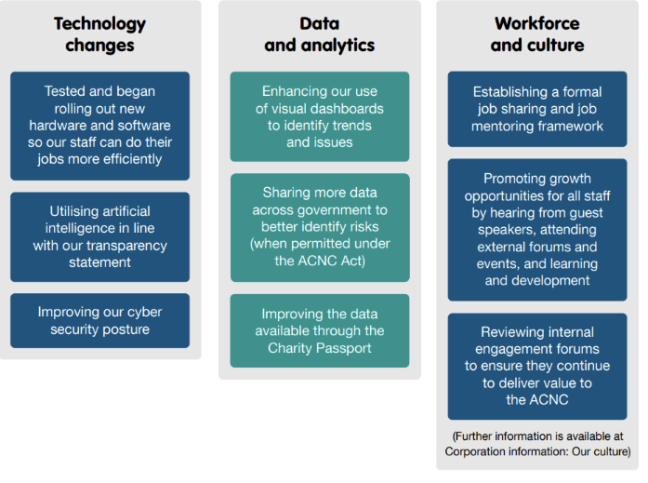
Data and analytics: Enhancing our use of visual dashboards to identify trends and issues; Sharing more data across government to better identify risks (when permitted under the ACNC Act); Improving the data available through The Charity Passport.
Workforce and culture: Establishing a formal job sharing and job mentoring framework; Promoting growth opportunities for all staff by hearing from guest speakers, attending external forums and events, and learning and development; Reviewing internal engagement forums to ensure they continue to deliver value to the ACNC.
(Further information is available at Corporation information: Our culture).
We engage and collaborate extensively with charities, peak representative bodies, advisers to charities and other stakeholders who work with or regulate the charity sector. This helps us better understand emerging issues, sector challenges and stakeholder perspectives, and allows us to deliver regulation that is fair, proportionate and transparent.
Figure 8 – Stakeholder engagement
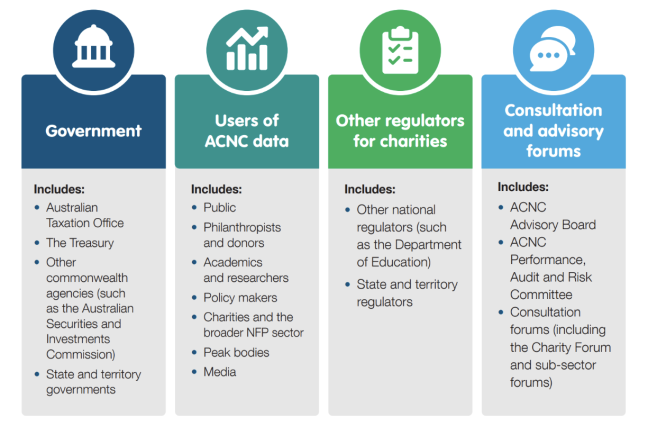
Users of ACNC data includes the public, philanthropists and donors, academics and researchers, policy makers, charities and the broader NFP sector, peak bodies and media.
Other regulators for charities include other national regulators (such as the Department of Education), and state and territory regulators.
Consultation and advisory forums include the ACNC Advisory Board, ACNC Performance, Audit and Risk Committee, Consultation forums (including the Charity Forum and sub-sector forums).
Government
We continued to work closely with the ATO to ensure a streamlined process from charity registration through to the ATO’s application of charity taxation concessions, and on other matters of mutual interest – including the ATO’s application of the self-assessing income tax exempt reforms.
We met regularly with Treasury, including regular engagement between the Commissioner and the Deputy Secretary of the Revenue, Small Business and Law Group.
In 2025–26, the Commissioner accepted an invitation to join the Regulator Leadership Cohort, which consists of heads of Commonwealth regulators or those responsible for a significant regulatory system or function in a Commonwealth department. The ACNC was also a member of various government forums and initiatives, including the:
- NFP Cyber Uplift Community of Practice Expert Advisory Group
- ATO Not-for-profit Stewardship Group
- Business Registers Inter-Agency Liaison Group, chaired by ASIC
- Fraud Fusion Taskforce.
Users of ACNC data (including the public)
The public – including donors, volunteers and beneficiaries – play a key role in supporting the charity sector.
The ACNC publishes guidance to help the public better understand the charity sector. We also publicly promote the Charity Register to encourage giving to legitimate registered charities.
Safe giving
In 2025–26, we again ran our ‘Safe Giving’ campaign in the lead up to the Christmas period when donations often increase. The campaign is designed to help people avoid scams and donate with confidence.
The campaign attracted national coverage across TV, radio and online, achieving audience reach of more than half a million people.
The dollar value of the coverage was estimated at $257,000. More than 100 commercial and community radio stations in capital cities, regional towns and remote areas of Australia used the ACNC’s media release in news updates, with some also playing short, pre-recorded interview grabs.
We responded to 233 media enquiries, and the ACNC received a total of 2,452 media mentions. Journalists, and the public, continue to be interested in charity activities and the role of the regulator in holding charities to account and ensuring they comply with the rules. They often quote our data and the particulars from the Charity Register entry for charities they are reporting on.
The Commissioner and senior leadership team had 17 speaking engagements. These engagements included speaking at the National Volunteering Conference, the Charity Law Association of Australia and New Zealand (CLAANZ) annual conference, and the Third Sector Leaders Forum.
Other regulators for charities
We work closely with other government regulators to help charities understand their broader obligations and navigate regulatory requirements.
The ACNC chaired various forums – including two whole-of-government forum involving all state and territory fair trading regulators and the ATO – to share insights and reduce unnecessary regulatory burden.
We also continued to engage with our international charity regulator counterparts to discuss global trends and issues that affect charities, and to also learn about country-specific developments that may foreshadow future trends for the Australian charity sector. In 2025–26, we met with various international counterparts on eight occasions.
In June 2026, the ACNC hosted a cross-agency 'Meet the Regulators' forum. This in person forum brought together charities and key regulators, including the ATO, the Office of the Registrar of Indigenous Corporations (ORIC), and the Western Australian regulator for charitable fundraising and incorporated associations.
The forum provided charities with an opportunity to hear directly from multiple regulators, ask questions and gain a better understanding of their regulatory obligations across different jurisdictions and frameworks.
We also invited other regulators – including the Victorian Social Services Regulator and the National Disability Insurance Scheme Commission – to present to ACNC staff at our monthly in person meetings.
We met with a range of regulators, such as the Department of Home Affairs, AUSTRAC, the Department of Education, the Fair Work Ombudsman and SafeWork NSW.
Where appropriate, we will also share information with other government agencies, including agencies that are part of the Fraud Fusion Taskforce. Sometimes another regulator is responsible for risks affecting a charity, such as serious criminal allegations. In those cases, our actions will take into consideration that regulator’s work.
In 2025–26, we received 89 referrals relating to 85 charities. Referrals came from state, territory and Commonwealth agencies. The ACNC referred 21 charities to other government agencies where we thought they may be better placed to respond to issues of concern.
As permitted, we also regularly share data securely with other regulators, which is covered in Priority 3 – Using our data to maximum effect.
Consultation and advisory forums
We held our ‘Governing for Good’ forum in July 2025. This forum provides the sector with key updates from the ACNC and other regulators, including the ATO and state and territory fair trading regulators.
The 2025 forum included discussion on the self-assessing income tax exempt reforms being administered by the ATO, as well as panels on managing risk overseas and supporting diversity in boards.
In 2025–26, we refined our stakeholder engagement strategy to:
- combine our Adviser and Sector forums to become the Charity Forum
- focus on additional sub-sector engagement.
The Charity Forum met twice. We also convened a specific forum for charities operating overseas to better understand the risks and challenges they faced.
There were four meetings of the ACNC Advisory Board, with meeting summaries available on our website.
Our contribution to the government’s productivity agenda
In July 2025, 30 regulators and eight portfolios were asked for ideas to improve regulation and reduce unnecessary burden.
The ACNC’s response, published in August 2025, committed to five key initiatives that, as requested, did not require legislative reform.
1. Updating our Commissioner’s Interpretation Statement on the provision of housing to support investment in social and affordable housing
Why is it important?
All levels of government have committed to helping more Australians access social and affordable housing, with new housing models being developed and refined to meet this goal.
This Commissioner’s Interpretation Statement helps charities, their advisers and the public to understand how we apply the law to charities’ provision of housing, noting that the provision of housing is not (of itself) a charitable purpose. Updating this statement – to the extent possible within the Charities Act 2013 (Cth) and case law – to reflect new and evolving government funding models provides greater help to organisations that require charity registration to apply for government funding, such as through the Housing Australia Future Fund.
What did we do?
We began public consultation in November 2025. We received 13 submissions from a range of stakeholders including charities, peak bodies, advisers, other regulators and policy makers.
Final submissions were received in March 2026, with some further targeted consultation across May and June.
Having reviewed the feedback, as of the date of this Annual Report (30 June 2026), the ACNC was finalising the substantially revised Commissioner’s Interpretation Statement: Community housing, with an expected publication date in August 2026.
2. Interaction between the ACNC Charity Register and ASIC’s Companies Register
Why is it important?
Charitable companies have identified the practical barriers and costs associated with having to provide the same information multiple times to transact with banks, service providers and third parties (including grant-makers).
This arises from inconsistencies between the information published on the ACNC Charity Register and the Companies Register operated by the Australian Securities and Investments Commission (ASIC).
Although charities are legally required to report to the ACNC rather than ASIC, and are not required to update their information on the ASIC Companies Register once they become a registered charity, it is common for third parties to prefer ASIC’s Companies Register to verify details such as officeholders and addresses.
What did we do?
We worked with ASIC to strengthen public messaging about the ACNC Register being the most up-to-date register for current directors of charities that are companies, and to ensure exemptions from ASIC fees for charities were more accessible and better understood.
In the 2026 Federal Budget, the ACNC and ASIC received funding to streamline ACNC data sharing with ASIC. The ACNC will use the funding to develop technology aimed at automating the transfer of key data to ASIC, a step towards eliminating a pain point for charitable companies.
This work is a positive first step, and the ACNC will continue to engage across government on further changes to resolve other issues associated with the Charity Register and Companies Register – some of which may require legislative amendment.
3. Using our registration application form to further streamline processes
Why is it important?
To be registered with the ACNC, charities must apply by completing our registration form. Our registration form also collects information on behalf of the ATO, which administers relevant tax concessions for charities.
What did we do?
In October, we improved the ACNC registration form so it directly collected information for eight deductible gift recipient categories now administered by the ATO. This streamlined the process for affected charities and reduced the need for the ATO to contact the charity for more information.
4. Mapping the regulatory pathway for charities and other not-for-profits as a baseline for ongoing improvements
Why is it important?
Charities continue to feel the impact of several concurrent regulatory reforms across all levels of government. Some affect all sectors (for example, Payday Super) and others are specific to activities carried out by the sector (for example, aged care accreditation).
Mapping the regulatory lifecycle of a charity will help identify pressure points, as well as any duplication (for example, the submission of similar information to multiple agencies), allowing for an informed discussion across different levels of government on opportunities to streamline processes and reduce unnecessary regulatory burden.
What did we do?
With help from the ATO, we developed a draft regulatory journey map based on four stages – establishment, registration, operations and winding up.
The ACNC discussed early draft maps with the ACNC Advisory Board. As of 30 June, we were working with state and territory fair trading regulators to review the maps and provide additional insights.
Following this, the ACNC will continue discussions with states, territories, and other Commonwealth regulators to finalise the journey map with the aim of reducing pressure points.
5. Improving user experience
Why is it important?
We regularly engage with charities, their advisers and other government agencies to seek advice on ways we can make it easier to use our website, processes and regulatory services. This engagement supports charities to comply with their obligations around ensuring the Charity Register remains accurate.
What did we do?
In addition to these actions, we:
- updated internal work instructions to allow ACNC staff to streamline processes for liquidators or administrators appointed to manage a charity to engage with the ACNC
- created an operational procedure to facilitate shared Charity Portal access for professional advisers who act on behalf of multiple charities
- added AI generated audio on our website to read news items aloud to improve accessibility
- started work to translate key guidance and resources into different languages, enabling the ACNC to support culturally and linguistically diverse communities and the charities serving them. This is expected to be published by December 2026.
Best practice principles
The ACNC is committed to regulating in accordance with the principles in the Regulatory Policy, Practice and Performance Framework.
While our work against these principles is embedded throughout this report, we have included some key examples below to demonstrate how we meet the three key principles of regulator best practice, as published by the Department of Finance.
Table 5 – Best practice principles
| Principles | Key examples |
|---|---|
| Principle 1 – Continuous improvement and building trust We adopt a whole‑of‑system perspective continuously improve how we regulate to build and maintain public trust and confidence in Australian charities. |
|
| Principle 2 – Risk based and data driven We manage risks proportionately and maintain essential safeguards while minimising regulatory burden. We also leverage data and digital technology to support those we regulate to comply and grow. |
|
| Principle 3 – Collaboration and engagement We are transparent and responsive communicators, implementing regulations in a modern and collaborative way. |
|
Corporate governance
The ACNC Advisory Board is established under the ACNC Act to support and advise the ACNC Commissioner. Under the ACNC Act, the Board is appointed by the Minister and consists of:
- up to eight general members with expertise in the not-for-profit sector, law, taxation or accounting, and specified office holders
- ex officio members, representing the governments of states and territories.
General members are appointed for a term of up to three years. Ex officio members remain on the Advisory Board for as long as they hold the specified office.
See summaries of Advisory Board meetings on our website.
General members
In 2025–26, general members included:
- Sarah Davies AM (Chair)
- Sara Harrup (Deputy Chair)
- Emeritus Professor Myles McGregor-Lowndes OAM
- Ian Hamm
- Rosa Loria
- Anna Bacik
- David Crosbie
- Nick Maisey.
Ex officio members
As of 30 June, there were eight ex officio members, each representing the fair trading regulator in their jurisdiction.
Preparation of this annual report
This Annual Report is prepared in accordance with Division 130 of the ACNC Act.
For the purposes of the Public Governance, Performance and Accountability Act 2013 (Cth) (PGPA Act), the Commissioner of Taxation is the Accountable Authority for the Australian Taxation Office listed entity, which comprises the ATO, Tax Practitioners Board, ACNC and ACNC Advisory Board.
Rob Heferen was appointed as the 13th Commissioner of Taxation and Registrar of the Australian Business Register, Australian Business Registry Services and Register of Foreign Ownership of Australian Assets on 1 March 2024. The Commissioner of Taxation’s Annual Report will include relevant information (including financial information) for the ACNC in compliance with the PGPA Act. For completeness, the ACNC spent $22.07 million in 2025–26, which includes remuneration for the Commissioner ($376,640) and general members of the ACNC Advisory Board as determined by the Australian Government Remuneration Tribunal.
Corporate governance
The ACNC Executive is the ACNC’s most senior committee. It includes the Commissioner and both Assistant Commissioners. It supports the Commissioner to set the ACNC’s strategic priorities and oversees our performance. The committee also resolves significant issues or matters escalated to it.
The ACNC manages risk in accordance with the ATO’s Enterprise Risk Management Framework and risk tolerance. For the purposes of the PGPA Act, the ACNC attends the ATO Audit and Risk Committee.
As a demonstration of our commitment to better practice, the ACNC has established a Performance, Audit and Risk Committee (PARC). PARC membership includes an independent chair and a member of the ACNC Advisory Board. An independent member of the ATO Audit and Risk Committee also attends the PARC.
The PARC met four times during the year.
External reviews
In 2025–26, the ACNC was included in two broader cross-agency reviews:
- the Financial Action Task Force (FATF) Mutual Evaluation of Australia, assessing Australia’s compliance with anti-money laundering, counter-terrorism financing and countering the financing of proliferation standards (the FATF Standards), being led by the Department of Home Affairs
- the Australian National Audit Office’s performance audit in relation to the effectiveness of the Fraud Fusion Taskforce.
The ACNC was also included in annual audits (for example, ANAO annual performance statement audits) for the Australian Taxation Office listed entity.
Senate Estimates and enquiries
During the year, we appeared before four hearings of the Senate Economics Legislation Committee.
We also appeared before Victorian Parliament’s Inquiry into the recruitment methods and impacts of cults and organised fringe groups.
Freedom of Information (FOI)
This year, we responded to 36 requests made under the Freedom of Information Act 1982 (Cth).
This includes initial decisions on FOI applications as well as internal reviews of FOI decisions. It excludes any request that was withdrawn after communications with the applicant.
All requests except two were responded to within the 30 calendar day statutory timeframe. One of these received an extension of time under s 26A of the FOI Act, and the decision was made within the extended time. The other was sent out after the statutory period due to a miscalculation of the processing time allowed.
In accordance with part II of the FOI Act, our Information Publication Scheme is published on our website.
Review and appeal of ACNC decisions
For certain decisions, the ACNC Act allows affected applicants to make an ‘objection decision’. These decisions are conducted internally by a different person to the one who made the original decision.
In 2025–26, we finalised six objections.
Table 6 – Objection outcomes 2025–26
| Outcome of objection | Number |
|---|---|
| Allowed (original decision overturned) | 2 |
| Disallowed (original decision upheld) | 2 |
| Invalid (decision not eligible for an objection, insufficient information provided to assess objections) | 2 |
| TOTAL | 6 |
If a charity is dissatisfied with our objection decision, it can apply for a review by the Administrative Review Tribunal (ART). Charities can also appeal directly to the Federal Court of Australia or seek review by the Federal Court if dissatisfied with an ART decision.
In 2025–26, there were no ART reviews or appeals to the Federal Court.
Table 7 – Reviews or appeals in 2025–26
| Reviews or appeals | Number |
|---|---|
| To the Administrative Review Tribunal | 0 |
| To the Federal Court of Australia | 0 |
Our staff
The ACNC is based in Melbourne and staff are engaged under the ATO Enterprise Agreement 2024.
Our headcount at 30 June was 130, including staff on unpaid leave (excluding the Commissioner), with 15% employed on a part-time basis.
Our ongoing staff retention rate was 87.2%. Most staff leaving the ACNC took up roles with another government agency.
Table 8 – People by APS level as of 30 June 2026 (excluding the Commissioner)
| Classification | Number of staff* |
|---|---|
| APS4 | 28 |
| APS5 | 23 |
| APS6 | 39 |
| EL1 | 27 |
| EL2 | 10 |
| SES1 | 2 |
| SES2 | 1 |
| TOTAL | 130 |
*These figures include any staff member at the ACNC as of 30 June, including ATO staff on temporary transfers to the ACNC, staff on higher duties and staff on leave.
Our culture
We are committed to creating a ‘One ACNC’ environment where people belong, are supported and connected, and aspire to continuously evolve.
To maintain our unique One ACNC culture, we:
- hold fortnightly One ACNC all staff meetings (rotating between in person and virtual) with guest speakers from across government and the charity sector
- hold a ‘People Network’ as part of our commitment to diversity, equity and inclusion
- have established an ‘Innovation Hour’ forum, which allows staff to discuss new ideas and initiatives
- recognise the contribution of our staff through informal and formal methods, such as thank you cards, our ‘praise’ channel and through formal awards presented at our annual Commissioner’s Award ceremony
- provide staff with a range of learning and development opportunities, in addition to training offered by the ATO, including access to higher education financial support and access to microlearning sessions
- have a social club that organises engaging events throughout the year.
We also aim to be representative of the Australian community and a place where all individuals can make a positive impact. We do this by recognising important events such as National Reconciliation Week, NAIDOC Week, International Women’s Day and International Day of People with a Disability.
In 2025–26, we published a Statement of Commitment to Aboriginal and Torres Strait Islander peoples and associated action plan. This complements the ATO’s Reconciliation Plan (which covers ACNC staff) and demonstrates how the ACNC, as the national charity regulator, can foster meaningful relationships with First Nations communities across Australia. The ACNC’s progress against our action plan can be found at Appendix A.
Table 9 – Statistics at 30 June 2026 extracted from ATO systems (excluding the Commissioner)
| % of staff | |
|---|---|
| Aboriginal and Torres Strait Islander peoples | 1.5 |
| Employees living with disability | 9.7 |
| Lesbian, gay, bisexual, transgender, intersex, queer (LGBTIQ+) staff | 11.9 |
| Neurodivergent | 6.7 |
| Culturally and linguistically diverse | 29.4 |
Note: It is important to note that not all staff choose to disclose the information above.
| ABN | Australian Business Number |
| ACNC | Australian Charities and Not-for-profits Commission |
| ACNC Act | Australian Charities and Not-for-profits Commission Act 2012 (Cth) |
| AM | Member of the Order of Australia |
| AFS | Address For Service |
| Annual Information Statement | The annual statement that registered charities must provide to the ACNC. |
| APS | Australian Public Service |
| ART | Administrative Review Tribunal |
| ASIC | Australian Securities and Investments Commission |
| ATO | Australian Taxation Office |
| Board | ACNC Advisory Board |
| Charity | An entity defined in section 5 of the Charities Act. Broadly speaking, a not-for-profit entity that has charitable purposes for the public benefit, that does not have any disqualifying purposes and that is not an individual, political party or a government entity. |
| Charities Act | Charities Act 2013 (Cth) |
| Charity Passport | A mechanism by which the ACNC shares publicly available charity information with other government agencies. An integral part of the ‘report once, use often’ approach to reporting. |
| Charity Portal | An online portal in which charities update details and submit reports and online information to the ACNC. |
| Charity Register | A freely available online public database of information about the charities registered with the ACNC. |
| CLG | Companies limited by guarantee |
| Compliance agreement | A compliance agreement is not a formal enforcement power under the ACNC Act, and a charity’s participation is voluntary. It is an action plan written by the ACNC in consultation with a charity which sets out what the charity needs to do to ensure it is not in breach of the ACNC Act or Regulations. The ACNC monitors the charity’s implementation of the agreement. If we are not satisfied with the charity’s progress, we may take further action. |
| FOI | Freedom of information |
| FOI Act | Freedom of Information Act 1982 (Cth) |
| Hon | The Honourable |
| Legislative enforcement powers | Includes enforceable undertakings, directions and warnings. We can use these powers if the charity is a ‘federally regulated entity’ as defined in the ACNC Act or if the charity is not complying with the External Conduct Standards. |
| MP | A member of parliament |
| MOU | Memorandum of Understanding |
| NFP | Not-for-profit |
| ORIC | Office of the Registrar of Indigenous Corporations |
| PARC | The ACNC's Performance, Audit and Risk Committee |
| PBS | Portfolio Budget Statements |
| PGPA Act | Public Governance, Performance and Accountability Act 2013 (Cth) |
| SAITE | The new reporting requirements administered by the ATO for self-assessing income tax exempt non-charitable not-for-profits. |
| SES | Senior Executive Service |
Appendix A
In 2025–26, we published a Statement of Commitment to Aboriginal and Torres Strait Islander peoples and associated action plan. This complements the ATO’s Reconciliation Plan (which covers ACNC staff) and demonstrates how the ACNC, as the national charity regulator, can foster meaningful relationships with First Nations communities across Australia.
The Assistant Commissioner – General Counsel and Regulatory Services acts as the ACNC’s Reconciliation Action Plan (RAP) plan champion.
Table 10 – ACNC progress against our Aboriginal and Torres Strait Islander peoples Action Plan
Commitment 1: Build our understanding and appreciation of First Nations cultures, governance and rights as the foundation for respectful relationships and services.
| Deliverables | Timeline | Responsibility | Update as of 30 June |
|---|---|---|---|
| 1.1 Maintain at least one position for First Nations representatives on the ACNC Charity Forum. | Annually | ACNC Commissioner | Delivered. The ACNC Charity Forum includes two First Nations representatives. |
| 1.2 Elevate Aboriginal and Torres Strait Islander perspectives at our ‘One ACNC meeting’, including through inviting guest speakers. | Annually | RAP Champion | Delivered. The ACNC organised two guest speakers to speak to staff in 2025–26, including an Indigenous Diversity Officer from the ATO. |
| 1.3 Provide staff training to understand relevant legal frameworks and the history behind them (for example, Native Title, ORIC-registered corporations). | Every two years | Director, Legal and Policy | Delivered. The ACNC and ORIC delivered a joint training session to ACNC and ORIC staff. |
| 1.4 Maintain the ACNC First Nations book library | Annually | RAP Champion | Delivered. We added new resources to the library, which was promoted via the ACNC’s internal newsletter. |
| 1.5 ACNC RAP Champion to attend at least one external forum/conference to support staff to better understand Aboriginal and Torres Strait Islander governance. | Annually | RAP Champion | Delivered. The RAP Champion attended 2 external events (including one attended by other regulators) to support ACNC staff to better understand Aboriginal and Torres Strait Islander governance. |
| 1.6 Organise ACNC specific cross-cultural awareness training. | Every two years | RAP Champion | Delivered. ACNC staff attended the Indigenous Governance Forum. The ACNC and ORIC also delivered joint training to staff. |
| 1.7 In collaboration with Wurundjeri Woi Wurrung Cultural Heritage Aboriginal Corporation, key meeting places in the offices will be named using Woi Wurrung language and staff are supported to understand the purpose of this initiative. | Annually | RAP Champion | Delivered. Three rooms use Woi Wurrung language names, with a poster to explain the significance of each of the names. We also display Indigenous art in our meeting room. |
Commitment 2: Collaborate with First Nations organisations, peak bodies and other regulators to reduce red tape and support charities to meet their obligations to the ACNC.
| Deliverables | Timeline | Responsibility | Update as of 30 June |
|---|---|---|---|
| 2.1 Maintain our Memorandum Of Understanding with ORIC to ensure it remains fit-for-purpose and provides a strong basis for collaboration. | Annually | Director, Reporting and Red Tape Reduction and Corporate Services | Delivered. The ACNC has an MoU with ORIC. |
| 2.2 Strengthen relationship between ACNC, ORIC and other regulators of Aboriginal and Torres Strait Islander charities, including collaborating and co-designing with agency Indigenous Liaison teams. | Annually | RAP Champion | Delivered. The ACNC continued to engage with ORIC (including training referred to as 1.3), as well as the Australian Indigenous Governance Institute. |
| 2.3 Promote a First Nations tailored resource (ACNC developed or externally developed i.e., ORIC, Australian Indigenous Governance Institute) in at least two editions of the ACNC’s monthly e-newsletter, The Charitable Purpose, per financial year. | Annually | Director, Advice Services and Education and Public Affairs | Delivered. The Charitable Purpose included First Nations external resources in four editions (for example, the February 2026 edition promoted a workshop being held by ORIC). |
| 2.4 Revisit guidance regarding use of deficit-based language in ACNC template governing documents. | By 30 June 2027 | RAP Champion | Mostly delivered. Two pieces of guidance were reviewed, with further updates to be made in 2026–27. |
| 2.5 Commence review of ACNC Commissioner’s Interpretation Statement on Indigenous charities. | By 30 June 2027 | ACNC Commissioner and Director, Legal and Policy | Not started. This will occur during 2026–27. |
| 2.6 Ensure Commissioner’s annual calendar of events includes engagement with First Nations charities. | Annually | ACNC Commissioner | Delivered. The Commissioner regularly engaged with First Nations charities – including through the Charity Forum – and attended the ACNC’s training with ORIC. |
Commitment 3: Strive to create an environment where Aboriginal and Torres Strait Islander employees thrive in fulfilling careers and a culturally safe workplace.
| Deliverables | Timeline | Responsibility | Update as of 30 June |
|---|---|---|---|
| 3.1 Communicate our commitment to reconciliation through the Commissioner’s Column, our social media and website. | Annually | Director, Education and Public Affairs | Delivered. The ACNC published our Action Plan: Statement of Commitment to Aboriginal and Torres Strait Islander Peoples and promoted it in a news article. |
| 3.2 Ensure that all One ACNC meetings begin with an Acknowledgement of Country. | Monthly | RAP Champion | Delivered. All One ACNC meetings begin with an Acknowledgement of Country. |
| 3.3 Monitor, tailor and implement ATO Aboriginal and Torres Strait Islander protocols guide. | Annually | RAP Champion | Delivered. The ACNC has implemented the ATO's protocol guide, which has been shared amongst ACNC staff. |
| 3.4 20% of all recruitment processes will include an Aboriginal and Torres Strait Islander affirmative measures. | Annually | RAP Champion | Mostly delivered. 19% of processes were affirmative measure processes. We have refined our processes to ensure each recruitment process considers affirmative measures. |
| 3.5 Review the Aboriginal Liaison Officer function to ensure an appropriate level of support is available. | By 31 December 2026 | RAP Champion | Mostly delivered. Work has commenced, and we expect to deliver on this action by 31 December 2026. |
Commitment 4: Foster accountability and transparency
| Deliverables | Timeline | Responsibility | Update as of 30 June |
|---|---|---|---|
| 4.1 Appoint a RAP Champion for the ACNC. | - | ACNC Commissioner | Delivered. The Assistant Commissioner – General Counsel and Regulatory Services is the ACNC RAP Champion. |
| 4.2 Report to the ATO against the ATO RAP actions and deliverables. | Quarterly | RAP Champion | Delivered. The ACNC provides the ATO with quarterly reporting on key activities and initiatives. |
| 4.3 Maintain and formalise a Statement of Commitment Working Group with a documented terms of reference to support the delivery of this plan. | - | RAP Champion | Mostly delivered. We are currently finalising the terms of reference for a Working Group to support the delivery of the Action Plan. |
| 4.4 Review and evaluate the Statement of Commitment to Aboriginal and Torres Strait Islander peoples. | Every 3 years | RAP Champion | Not started. Our Statement of Commitment was approved in 2025. The next review will commence in 2028. |
| 4.5 Report our progress in the Annual Report against both the ATO RAP and the Statement of Commitment Action Plan. | Annually | ACNC Commissioner | Delivered. This table includes an update on our progress. |