

The ACNC Corporate Plan 2025-26 is included as a section in the Australian Taxation Office (ATO) Corporate Plan 2025-26.
Commissioner's forward

As the Commissioner of the ACNC, I am pleased to present this section of the corporate plan.
As Australia’s charity regulator, we understand our operating environment is always changing, informed by the data we collect and the insights we receive from the charity sector, the public and across government.
We use our data to make evidence-based decisions, including to:
- identify risks for certain parts of the charity sector, allocating resources to emerging and established issues that affect our regulation of charities
- help the public, government and other stakeholders better understand the important work of the charity sector via our annual Australian Charities Report
- provide insights to government agencies to reduce red tape and work together where there is a risk to public trust and confidence.
The Charity Register – our key means of promoting trust and confidence in Australia’s charities – contains detailed information for over 63,000 charities.
Our data shows that the number of registered charities is growing, largely due to the self-assessing income tax exempt reforms being administered by the ATO. These are not new organisations, but ones that have been operating for years or even decades. Due to these reforms, we expect to register a higher number of charities than usual in 2025–26, and we are committed to using our data and insights to support these charities to comply with their obligations to the ACNC.
We are also committed to investing in our staff, improving on our data capability and working across government to maximise the use of our own data.
While the ACNC is an independent body with our own Act and regulations, we benefit from a strong relationship with the ATO for corporate services, with staff enjoying the support and benefits of being under the ATO enterprise agreement.
I remain committed to working closely with the Commissioner of Taxation as the Accountable Authority for the ACNC and ACNC Advisory Board.
Sue Woodward AM
ACNC Commissioner
The following diagram represents the key elements as required in a corporate plan under subsection 16E(2) of the PGPA Rule. In addition to these requirements, we have also included our vision.
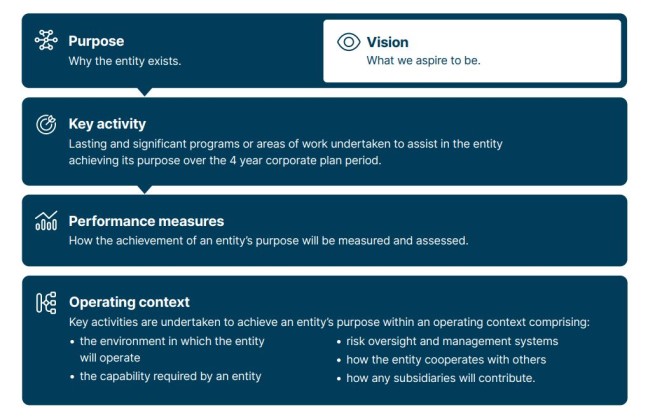
Vision: what we aspire to be.
Key activity: lasting and significant programs or areas of work undertaken to assist in the entity achieving its purpose over the 4 year corporate plan period.
Performance measures: how the achievement of an entity’s purpose will be measured and assessed.
Operating context: key activities are undertaken to achieve an entity’s purpose within an operating context comprising: the environment in which the entity will operate, the capability required by an entity risk oversight and management systems, how the entity cooperates with others and how any subsidiaries will contribute.
Our purpose is to promote public trust and confidence in Australian charities. We will achieve this through the following key activity and measurement of our performance.
Maintaining a free and accurate register of Australian charities (the Charity Register).
Performance measures
Availability
- Percentage of time that the Charity Register is available (excluding scheduled maintenance).
Registration
- Percentage of new eligible charities registered within 15 business days of ACNC receiving all information necessary to make a decision.
Organisational capability
We cannot achieve our purpose without our staff. Our employee value proposition, culture and commitment to continuous improvement help us to deliver 3 key areas of capability.
Workforce
While we use corporate services from the ATO, we maintain our own corporate governance, finance and people and culture functions.
Our culture is one where people belong, are supported and connected, and aspire to continuously evolve. We have a high-performing workforce, and we continue to invest in our existing staff and recruit people with the right skills and attributes. This includes having a demonstrated interest in, or having worked or volunteered in, the not-for-profit (NFP) sector.
Technology
The ACNC was established as a ‘digital by default’ agency. The Charity Register is only available online, and charities manage their interactions securely online via the ACNC Charity Portal.
To ensure our processes are inclusive and accessible for all stakeholders, we offer alternative methods of communication while providing user-friendly online services to make it quicker and easier for charities to comply with their obligations.
We are committed to ensuring our digital capability is innovative, fit-for-purpose and complies with the Australian Government’s Data and Digital Government Strategy. We will continue to evaluate how we effectively manage data security in the face of rapidly evolving cyber risks. While we do not currently use AI in any of our external services or in the production of any external advice, we will be transparent about future use of AI in line with our transparency statement.
Data and analytics
We collect a large amount of data about the Australian charity sector and the landscape that charities and NFPs operate in.
We use that data to identify risks, insights and trends, which in turn helps us to develop targeted guidance for the sector about emerging issues or risks. This supports our risk-based approach to compliance and allows us to protect and maintain public trust and confidence in the sector.
We are committed to sharing our data and insights as widely as possible to help inform the public, donors and other stakeholders about the charity sector. Our data is used to shape our policy submissions, ensuring all levels of government understand the impact of proposed reforms on Australia’s charities.
We also share the data we collect directly with government agencies via secure channels such as the Charity Passport. This helps to reduce unnecessary regulatory burden on charities by removing the need for other regulators to ask for duplicated information.
Environment
Our ability to maintain public trust and confidence in the charity sector is shaped by our operating environment. Some factors (such as global issues faced by all organisations) are out of our control. A range of government inquiries, policies and reforms may also affect our ability to achieve our purpose.
Self-assessing income tax exemption reforms for the not‑for-profit sector
As part of the self-assessing income tax exempt reforms being administered by the ATO, around 100,000 NFPs will be required to submit an annual return to the ATO to maintain income tax exemption. Some of these NFPs are charitable and instead will need to register with the ACNC as a charity if they want to maintain their income tax exempt status.
The number of organisations that require ACNC registration is unknown, as is the timing of their applications. As such, the ongoing implementation of this reform may affect our ability to register new charities in a timely manner.
Our 2023–24 annual report showed we received 6,286 registration applications – an increase of 751 (14%) compared to 2022–23 and the highest number received since our establishment in 2012. At least half of the applications received so far in 2024–25 relate to these reforms.
We expect to receive a higher number of applications than usual in 2025–26 as the ATO contacts NFPs that have yet to submit a self-review return. Additionally, we will continue to work with the ATO to identify and contact NFPs that:
- lodged the self-review return but should be registered with the ACNC as they have charitable purposes
- have indicated on their return that they are ‘unsure’ if they are eligible to be an ACNC-registered charity.
We are working with key charity and NFP stakeholders, including peak bodies, to help streamline the registration process. We will continue to promote and refine our guidance, such as our self-assessment tool, which helps NFPs to identify whether they are charitable. With support from the ATO, we have engaged some additional temporary staff.
These newly registered charities will need support to understand and comply with their obligations to the ACNC, including the requirement to submit an annual return to the ACNC (the Annual Information Statement). Data from the Annual Information Statement is used to update the Charity Register, ensuring it remains accurate. The ACNC is committed to offering a range of support to help charities submit their Annual Information Statement. Our aim is to prevent them from being revoked as part of our ‘double defaulter’ process, where we revoke charity status from any charity that has not submitted 2 or more Annual Information Statements.
Potential reforms the ACNC may need to implement
We may need to implement reforms associated with:
- the Productivity Commission’s inquiry into philanthropy
- the Department of Social Services’ Blueprint Expert Reference Group.
The 2023–24 budget announced reforms to the ACNC’s Secrecy Provisions, parts of which required legislative change. The required legislative changes were not passed during the previous term of Parliament.
We will proactively share our data and insights to ensure the impacts of potential reforms are clearly understood. We will work with government (including Treasury) when implementing any reforms. We will support affected charities by providing guidance and sharing information, including with our consultation forums.
Emerging risks to public trust and confidence in Australia’s charities
Our annual Australian Charities Report showcases the significance and diversity of the charity sector.
The 11th edition shows that while the charity sector employs 1.54 million people, over half operate with no paid staff.
Around 30% of charities are extra small, generating revenue of less than $50,000 and representing just 0.1% of the charity sector’s total revenue. While extra large charities (with revenue greater than $100 million) represent just 0.5% of charities, they generate 56% of the sector’s revenue.
Our data affirms that we need to be mindful of tailoring our regulatory approach to different parts of the diverse sector we regulate. Across our education, guidance, registration and reporting services, we need to consider existing and emerging risks to effective governance when charities operate in different contexts – such as when different regulators are involved.
The circumstances of the charities we regulate also vary widely. This can range from small volunteer-run charities that operate in high-risk settings through to large global charities with complex structures that include a mix of for-profit entities, and everything between.
There are also areas of risk that we place enduring focus on. These risks are relevant for charities of all types and sizes. They include conduct that harms people, misuse of charities to foster extremism, misuse of charities for terrorist purposes, financial mismanagement, and charities that have a disqualifying or non-charitable purpose.
We share our insights to support the sector to better understand the level of charity governance that we expect. We will investigate new opportunities to maximise the use of data we receive from other government agencies, to ensure the most efficient and effective use of resources. We will work with all levels of government to reduce any unnecessary regulatory burden.
Pressures faced by charities
Charity resources will continue to be stretched due to:
- increasing demand among people experiencing vulnerability, who turn to charities for help when impacted by cost-of-living pressures
- economic uncertainty driven by inflation, geopolitical tensions and rising operational costs (including insurance premium increases), energy pricing, cost pressures being felt throughout supply chains and higher employee expenses associated with a tight labour market
- the resources required to recruit, support and retain volunteers.
At the same time, charities need to manage increasingly complex risk landscapes, including privacy risks, the continuously evolving nature of cyber-threats and disinformation risks. Charities often hold the personal information of beneficiaries and donors, and it is important for charities to protect themselves from cyber risks and manage cyber security incidents.
We help the public and charities by promoting the Charity Register, which allows the public to easily find a registered charity. Charities can also use the Charity Register to find like-minded organisations to work with.
We will also continue to support the charity sector to manage risks through tailored and fit-for-purpose guidance. We are committed to refining our guidance based on any new findings, including from our 2024–25 compliance reviews into cyber security.
The cumulative impact and pace of regulatory reform and initiatives on charities
Charities continue to be impacted by a range of concurrent regulatory reforms across all levels of government.
The number and pace of these reforms have a significant impact on charities, half of which operate with no paid staff.
In the coming years, charities may be affected by several reforms, including:
- reforms associated with government inquiries and reports
- changes to privacy laws
- changes to the NFP financial reporting framework by the Australian Accounting Standards Board
- a range of state or territory government initiatives.
When regulatory changes are being developed by other agencies, we work with them to help minimise unnecessary red tape for charities. We will also share updates and guidance to help charities to understand new obligations.
Cooperation
We are committed to working with stakeholders to deliver on our vision and purpose.
Cooperation with these organisations helps us ensure we are a better practice regulator in line with the government’s 3 best practice principles.
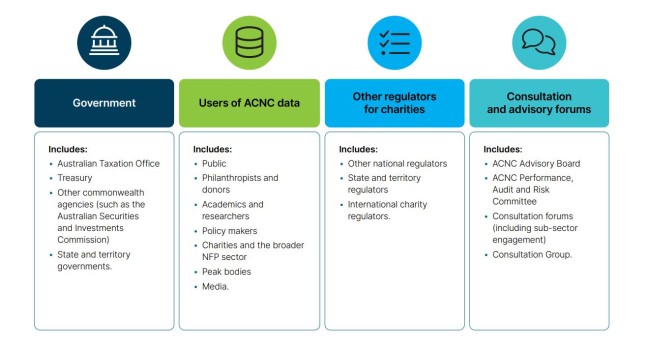
Other regulators for charities include other national regulators, state and territory regulators, and international charity regulators.
Users of ACNC data includes the public, philanthropists and donors, academics and researchers, policy makers, charities and the broader NFP sector, peak bodies and media.
Consultation and advisory forums include the ACNC Advisory Board, ACNC Performance, Audit and Risk Committee, Adviser Forum, Sector Forum and Consultation Group.
Government
We collaborate with all levels of government to reduce unnecessary burden, share data, and discuss regulatory issues and trends across the charity sector. We are an independent body, but we enjoy a strong working relationship with the ATO and the Commissioner of Taxation (as the Accountable Authority), noting we form part of the Australian Taxation Office listed entity for the purposes of the PGPA Act.
Users of ACNC data
The Charity Register is our key means of promoting public trust and confidence in the charity sector. We publish guidance and charity sector data to help users understand the diversity and contribution of the charity sector. Data from the Charity Register is also published to data.gov.au for researchers and other policy makers.
Consultation and advisory forums
We collaborate with various forums in accordance with our Stakeholder Engagement Framework, to support continuous improvement. As part of our commitment to transparency and accountability, we have our own Performance, Audit and Risk Committee, which is in addition to the ATO’s Audit and Risk Committee.
Other regulators for charities
We share data with other regulators to reduce the regulatory burden on charities and where there is a common risk to public trust and confidence. We meet frequently with those regulators, which helps us to better understand the environment in which charities operate, share our insights and learn from our counterparts to continually improve our performance. The ACNC Advisory Board includes ‘ex-officio’ members from state and territory governments, fostering continued collaboration across all levels of government.
Regulator performance
As the independent Commonwealth regulator of charities, we are responsible for registering new charities, as well as administering the national regulatory framework for over 63,000 charities.
Our key activity is to maintain a free and accurate register of Australian charities (the Charity Register) and we are committed to having the Register available as much as possible.
We are committed to:
- maintaining the accuracy and integrity of the Charity Register
- by registering new charities in a timely manner
- through our Register integrity work, which includes reviews of charity entitlement of deductible gift recipient-endorsed charities, monitoring and enforcement activities and revocation of charity status for those who persistently fail to meet their reporting obligations via our double defaulter process.
- helping charities to understand and meet their obligations through guidance, advice and other support
- informing public policy makers, researchers and the media about the work of the charity sector through submissions, reports, advice and other support
- working with all levels of government to share our data to reduce regulatory burden and highlight the impact that reforms will have on charities.
Our Regulatory Approach Statement outlines our approach to regulating charities.
Most of our effort is focused on education in line with our regulatory approach, and in acknowledgement that 73% of charities are small and have limited resources. We know that most people involved in charities are honest, act in good faith and try to do the right thing. However, we will not hesitate to act where there is a risk of harm to the public or serious wrongdoing.
As we perform a regulatory function, we have embedded the Australian Government’s 3 best practice principles into everything we do.
Regulator reporting
| Element | Continuous improvement and building trust | Risk based and data driven | Collaboration and engagement | |
|---|---|---|---|---|
| Key activity | Maintaining a free and accurate register of Australian Charities | Tick icon | Tick icon | Tick icon |
| Stakeholders | Government | Tick icon | Tick icon | Tick icon |
| Users of ACNC data | Tick icon | Tick icon | Tick icon | |
| Consultation and advisory forums | Tick icon | Tick icon | Tick icon | |
| Other regulators for charities | Tick icon | Tick icon | Tick icon | |
| Performance measures | Percentage of time that the Charity Register is available (excluding scheduled maintenance) | Tick icon | Tick icon | Tick icon |
| Percentage of new eligible charities registered within 15 business days of ACNC receiving all information necessary to make a decision | Tick icon | Tick icon | Tick icon | |
| Regulator Statement of Intent | Tick icon | Tick icon | Tick icon | |
Our Ministerial Statement of Expectations and Regulator Statement of Intent are publicly available on the Treasury website.
Risk management
We adopt the ATO’s Enterprise Risk Management Framework and risk tolerance.
We are:
- willing to accept higher levels of risk where there is a clear opportunity to realise benefits and where risks can be controlled to acceptable levels
- less willing to accept risk where it is not clear that benefits will be realised or where risks are unable to be controlled to acceptable levels.
Enterprise risks that affect our ability to achieve our vision and purpose are listed below, along with our strategies to contain these risks within acceptable levels.
| Enterprise risk | Risk description | Management strategy |
|---|---|---|
| Maintaining the accuracy of the Charity Register | There is a risk that the Charity Register contains charities that are not entitled to registration, which may undermine public trust and confidence in the ACNC. | We conduct risk assessments of all registration applications and review a sample of our decisions. We use a risk-based approach to inform our Register integrity work, to ensure charities remain entitled to registration. We revoke the status of charities that persistently fail to meet their reporting obligations via our double defaulter process. The risk-based approach includes data analytics, profiling and using public and government information to identify charities at highest risk of non-compliance. |
| Managing cyber risks | There is a risk that data held by the ACNC may be deleted, manipulated, stolen or misused, undermining trust in the ACNC and government. | We continue to enhance cyber security capabilities on our systems, which includes prioritising security patches and updates, to ensure we better meet whole‑of-government requirements. We continue to actively manage the security settings of our website (including the Charity Register and Charity Portal) to ensure it is safe to use. |
| Strategic workforce planning | There is a risk that as a small agency with limited resources, our staff may not have the right tools or skills required for the future. This may compromise our ability to provide quality services to charities, the public and government. | We constantly monitor our external environment to identify tools that can assist our staff to complete their job more efficiently. We also use our relationships with our consultation forums, Advisory Board, the ATO and Treasury to ensure we are aware of our operating environment and how this may impact on future skills we may require. We use a range of different recruitment strategies to ensure we find the people with the right skills. We continue to implement initiatives such as our Culture Vision and Census Action Plan. We are committed to developing our staff through learning and development opportunities. |
The ACNC Advisory Board is established under section 135‑15 of the ACNC Act.
The board meets quarterly to support and advise the ACNC Commissioner. Board members are appointed by the Assistant Minister responsible for the ACNC.
The board:
- includes up to 8 ‘general members’ with expertise in the not‑for‑profit sector, law, taxation or accounting
- can include ‘ex officio’ members appointed to the board because they hold a specified office.
The Chair of the Advisory Board provides an update after each meeting that is published on our website.
Details of current board members and meeting summary updates are available at acnc.gov.au.
Performance target | |||||
| Key activity | Performance measure | 2025–26 | 2026–27 | 2027–28 | 2028–29 |
| Maintaining a free and accurate register of Australian charities (the Charity Register) | Percentage of time that the Charity Register is available (excluding scheduled maintenance) | 99% | 99% | 99% | 99% |
Rationale for measure: The Charity Register is the ACNC’s key means to promote public trust and confidence in charities. It is the only register of Australian charities and is used by the public, volunteers, donors, charities, government agencies, the media and researchers to identify and access information on registered charities. This measure looks at our effectiveness in ensuring the Charity Register is available with as little interruption as possible. It excludes scheduled maintenance (for example, where we may need to apply security updates).
Rationale for target: We have used results from 2023–24 and 2024–25 year-to-date to refine our target. Due to the provision of back-office services by the ATO, the availability of the Charity Register can be affected by ACNC or ATO-specific issues. This has been factored into our target.
Data sources: Charity Register, Uptime Robot and Google Analytics.
Methodology: The number of minutes that the Charity Register is available divided by the total number of minutes in the financial year, less time scheduled for maintenance.
Comparison to 2024–25: Target changed from ‘95%’ to ‘99%’ in 2025–26 to ensure appropriate and meaningful performance measurement noting additional data sources are being used.
Performance target | |||||
| Key activity | Performance measure | 2025–26 | 2026–27 | 2027–28 | 2028–29 |
| Maintaining a free and accurate register of Australian charities (the Charity Register) | Percentage of new eligible charities registered within 15 business days of ACNC receiving all information necessary to make a decision | 90% | 90% | 90% | 90% |
Rationale for measure: The Charity Register only contains details of registered Australian Charities and is used by the public, donors and government. This measure looks at our efficiency in registering new charities, which promotes an accurate Charity Register.
Rationale for target: The target has been informed by historical performance.
Data sources: Microsoft Dynamics.
Methodology: The number of new eligible charities registered within 15 business days of the ACNC receiving all information necessary to make a decision divided by the total number of eligible charities registered.
Comparison to 2024–25: Target changed from ‘at or above previous year’s results’ to ‘90%’ in 2025–26 to ensure appropriate and meaningful performance measurement.